19 smart ways to use the MailerLite email marketing MCP server

 CTO, Nikola.
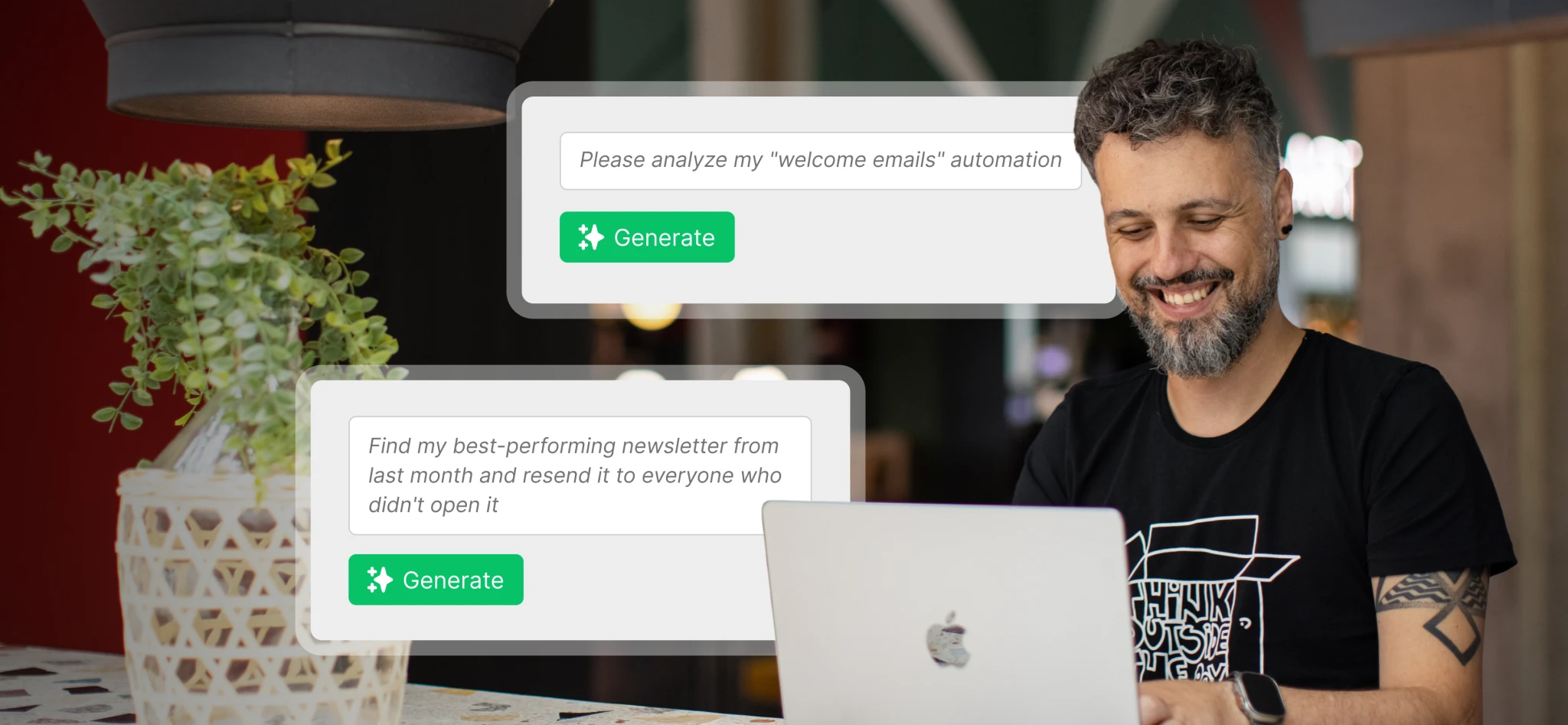
Email marketing MCP servers let you use AI tools to chat with your email data. Just ask a question or tell the AI to perform a task, and it will take action without you needing to lift a finger.
It’s a new and exciting way to manage email marketing that complements your expertise and helps you get more from your email platform. We created this article to help you master the technology; it's packed with setup tips and our favorite ways to use the tool.
What is an email marketing MCP server?
An email marketing MCP server uses Model Context Protocol (MCP) to let AI tools interact with external software. It gives the AI agents controlled access to your data and allows it to perform specific actions within the connected tool.
This means that instead of manually completing tasks in the tool’s dashboard, you can run parts of your workflow using natural language. For example, MailerLite’s MCP server lets you prompt the AI to create email campaigns, analyze your data, create segments, and more.
MCP helps you do more and do it better
You can save a lot of time when you ask an AI agent to perform a task for you. And it can help you build more effective campaigns too.
For example, before setting up MCP Hidden Holland founder and solopreneur Gerrit van den Berg never had time to do email analytics, meaning he was “really flying quite blind with email.”
But now he can get all the information he needs faster, allowing him to create more effective campaigns: “I can just ask a simple question while having a cup of tea.”
Meanwhile, our email lifecycle manager Risper Karanja finds that MCP has seriously reduced the time she spends on "setup, analysis and quality assurance work.”
This frees her up to spend more time on what she’s best at: creating strategy, writing copy, and actually building the emails in MailerLite.
So how does an email MCP server actually work?
MCP gives your AI tool access to a wide range of endpoints across your account. These are the individual actions and functions within MailerLite, like adding a subscriber or creating a campaign. In MCP, these endpoints are called tools, and MailerLite has over 40 and counting.
Each tool can be used to perform specific actions. For example:
create_group: Creates a new subscriber group
list_automations: Lists all automations and filter by name, group, enabled status
create_automation: Creates a draft automation
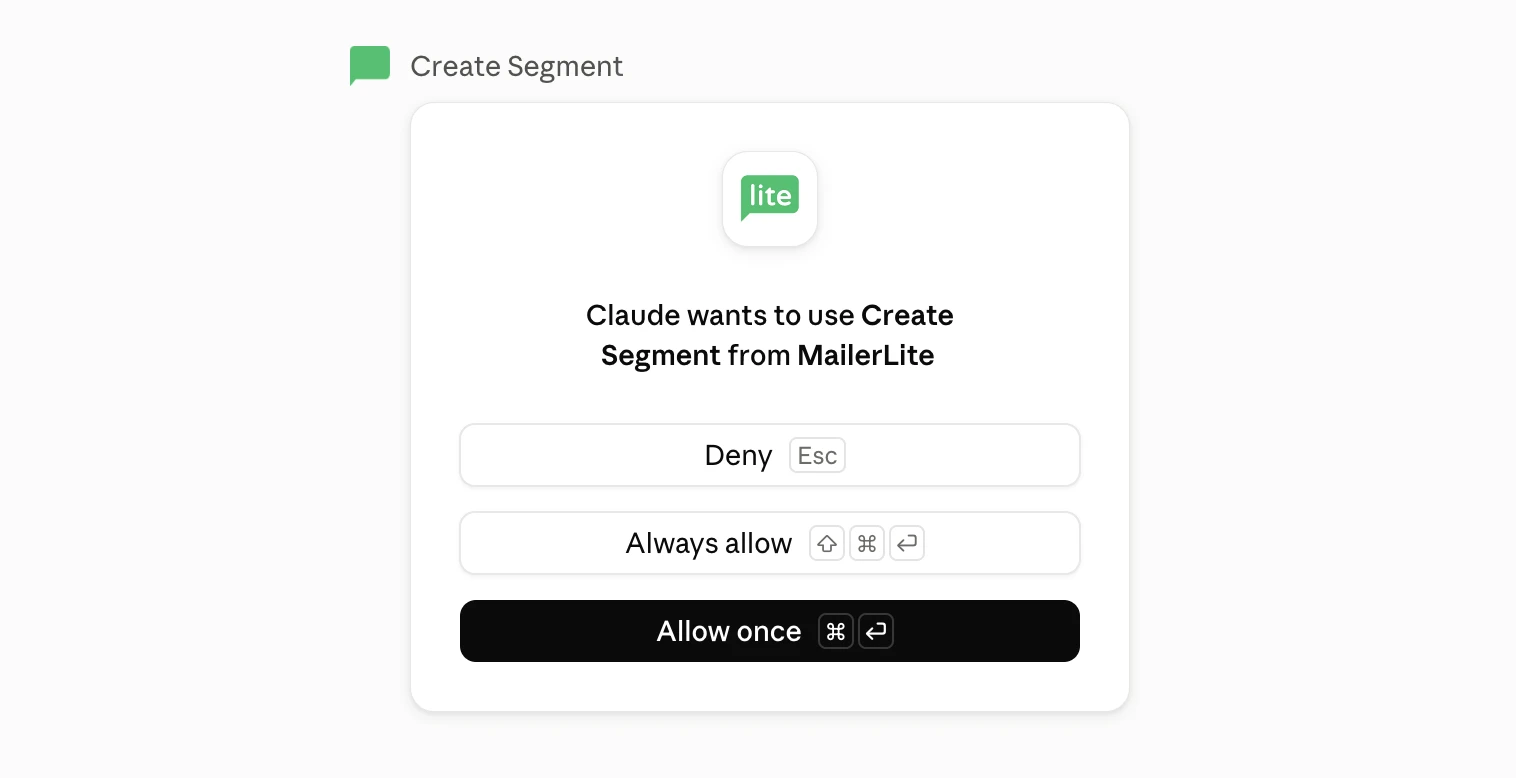
Your AI needs permission before it can access any particular tool. When it wants to use one for the first time, you’ll see a dialog box asking for your permission.
From this box, you can choose to either allow it once, allow it every time, or not allow the AI platform to use the tool. This gives you greater control over what the AI tool can see and do in your account.
You can also head into the MCP server’s settings and choose which tools you want to give the tool access to in advance. This is how these options look in Claude.
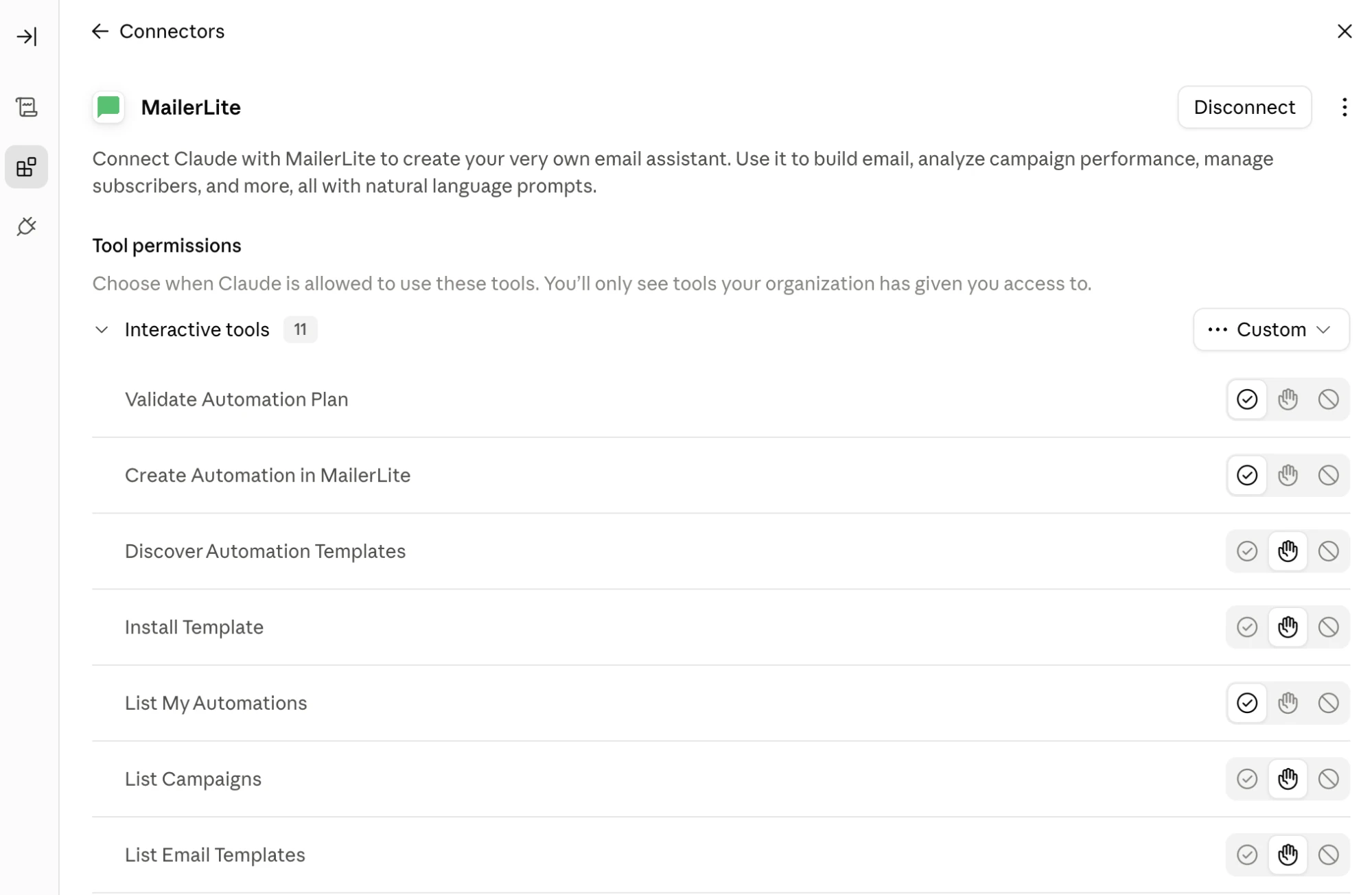
You can do a ton with the tools we currently have available; see the use cases in the section below. We also aim to keep building out the tools so that you can do more and more via MCP.
The fun part! What can you do with an email marketing MCP server?
We’ve spent the year since our MCP server was released experimenting with use cases and talking to people who use the tool. Here are 19 of the most exciting use cases we’ve found, split into 3 categories:
Email analytics: Analyzing your email marketing data to learn about campaigns and get tailored suggestions
Performing tasks: Taking actions in your account without ever leaving the AI tool
Advanced workflows: Performing actions across multiple connected tools, or using advanced AI features like scheduled tasks
Now onto the list.
MCP for email analytics
Once connected to MailerLite, your AI tool can quickly provide updates, summaries and reports based on your stats. It can also go beyond analysis and give you actual recommendations for what to do next. Here are some ideas you can use.
1. Analyze campaign performance
Ask AI agents for an analysis of your most recent campaign. Use it to see what went well and where there’s room to improve. The AI tool can also suggest ideas for future campaigns and compare the campaign to previous ones.

2. Analyze and improve any of your automations
Automations are more complex than campaigns; truly understanding how they perform can be difficult and time-consuming. Asking your AI to perform the analysis instead can help.
Your AI tool can provide an overview of performance to identify where the biggest drop-offs are and suggest ways to improve, whether that’s trying new subject lines, adding different offers, or adjusting the steps you use.

3. Get suggestions for new automations
Automations get sky-high engagement and convert at a higher rate than campaigns. The more you create, the more of these benefits you’ll get. If you aren’t sure which automations to build, simply ask the MCP server for suggestions.
The tool will analyze your existing automations and use its existing knowledge of what works for your business type to suggest automations that you can set up. Once you have new ideas, you can even ask the AI agents to build them out for you. More on that in tip 11 below.
4. Create a personalized content calendar
One of the biggest challenges MailerLite customers face is knowing what to send in every newsletter. That’s why our content ideas articles are so popular.
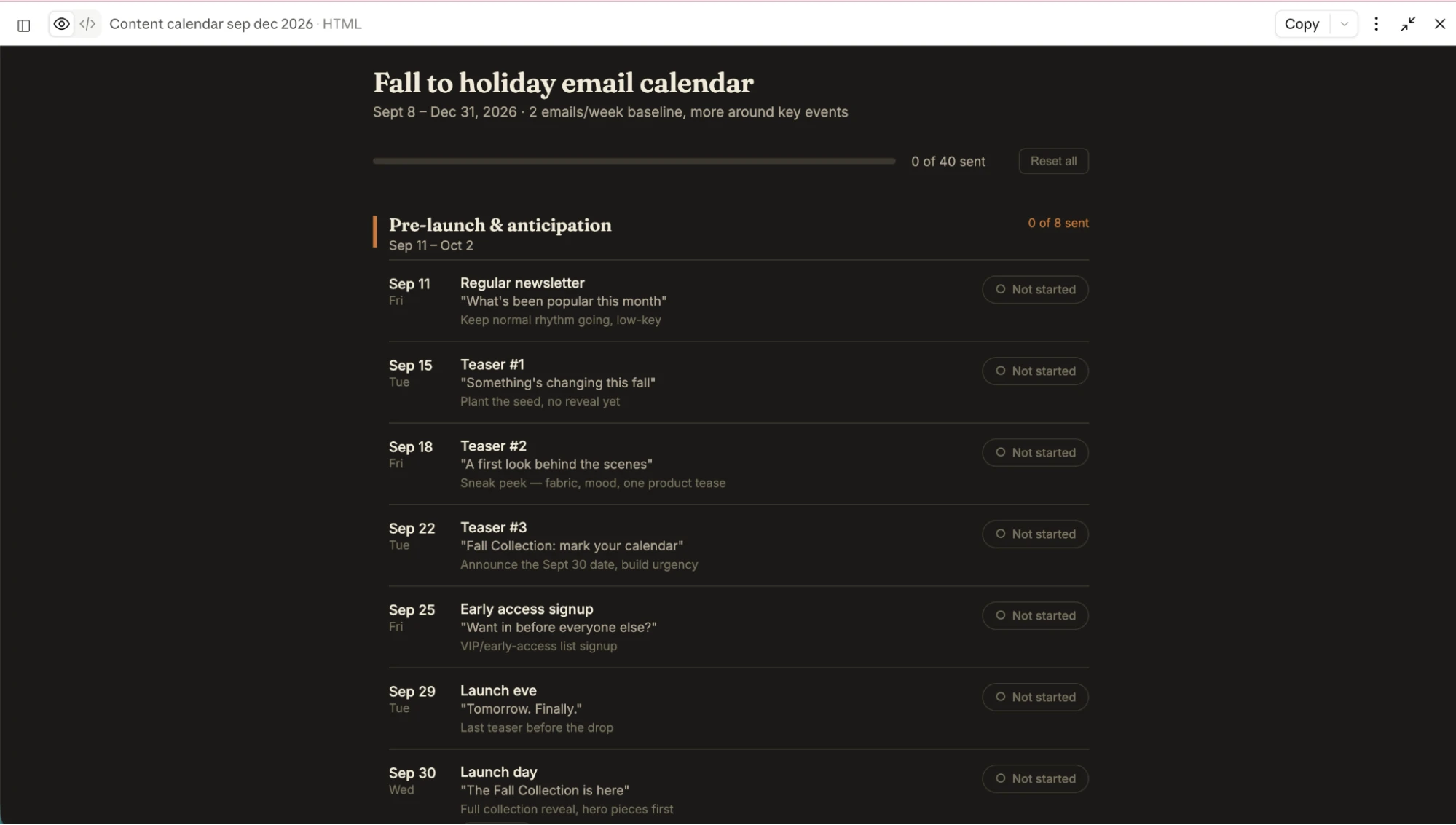
With the MCP server, you can simply ask the tool to create a content plan based on what has worked in the past and your business and email marketing goals.
For the calendar below, we asked for a plan for sending twice a week that included a fall collection release, Black Friday sale, and a holiday offer. We also asked for a way to mark each newsletter as “Not started,” “In progress” and “Done.”
5. Create custom reports
Use MCP to analyze your email marketing data and then create custom reports based on your needs.
Tools like Claude can take your data and then present it in a visually appealing report that shows exactly how your business is performing. You can even ask it to add suggestions, analysis, and takeaways.
You could also set up scheduled tasks to create the same report each week. Agencies and freelancers could then send this report to clients, or marketing managers could use it to show their bosses the impact of their campaigns.
6. Check automations work as they should
Automations can get pretty complex when you add in multiple conditions and logic. Use the MCP to double-check that all the steps are working as expected.
This tip was suggested by our client Kamil from the language learning app Vagaru. He uses it to check whether the conditions and logic in their automation are set up correctly.
He was so happy with the result that he’s already recommended MCP to his friends.
7. Suggest high-performing subject lines for future campaigns
Your subject line is one of the most important parts of your campaign since it’s what encourages people to open your messages.
When planning your upcoming campaigns, ask the AI tool to look at the subject lines that have performed well in the past and use the analysis to suggest ones for your upcoming campaign.
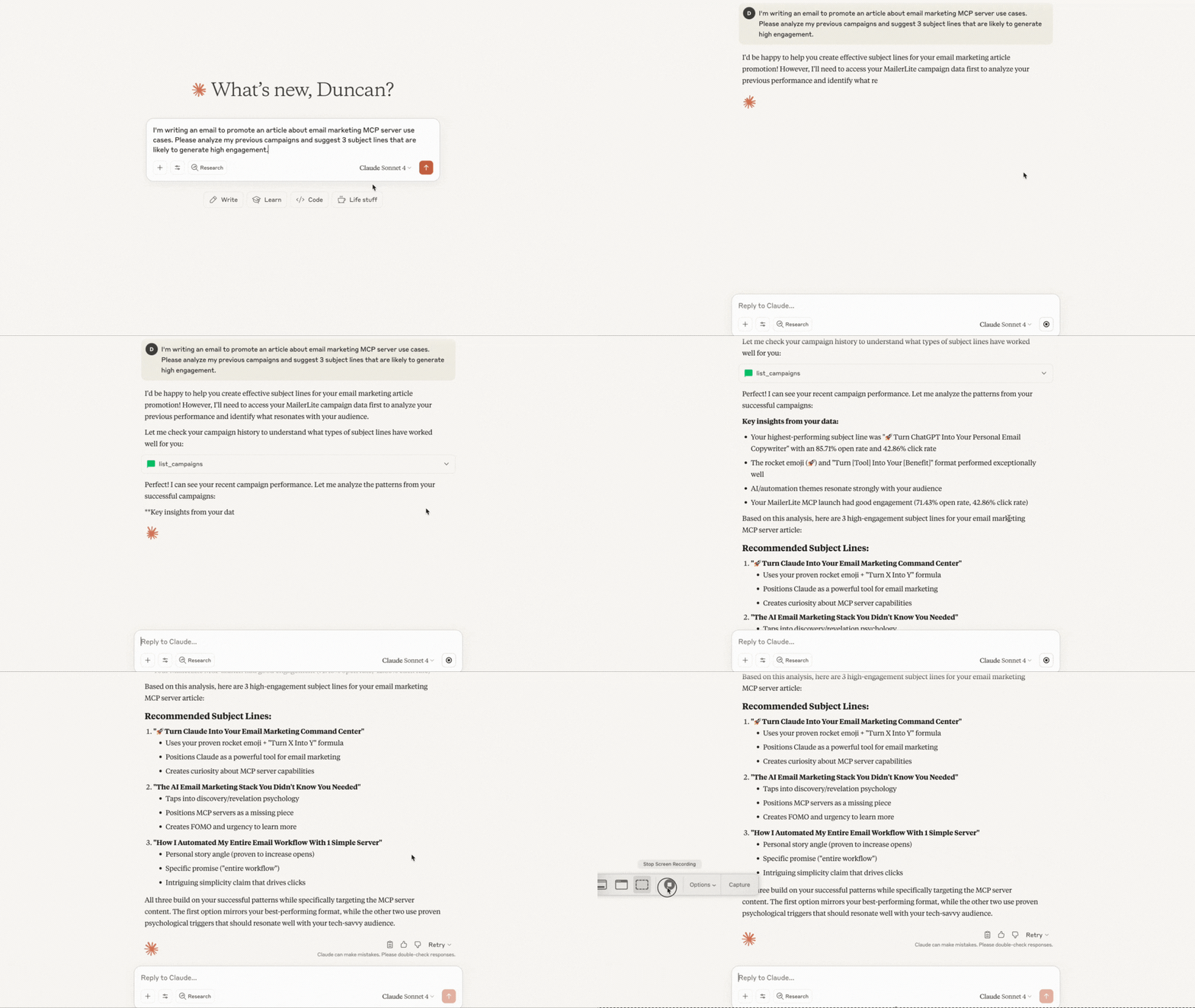
8. Map out the customer lifecycle
This is a good use case if you already have a complex email marketing strategy in place, like we do at MailerLite.
Our email lifecycle manager Risper Karanja uses the MCP server to help map out how all our different campaigns and automations fit together. It helps her look at the customer journey as a whole, identify gaps, and see where we might have opportunities to improve the lifecycle.
Email MCP for performing tasks
Save time by using the MCP server to perform actions inside MailerLite. You can currently perform tons of tasks that you would otherwise have to head into the dashboard to do.
9. Create a campaign
There are two ways to build a campaign in MailerLite from your AI tool.
The first is to set up a campaign with all details such as sender address and subject line and then head over to MailerLite to actually build out the content with our drag and drop or simple email editor.
The other option is to upload the email HTML too. This will upload the code to the HTML editor so you end up with a complete email ready to send.
10. Schedule or send a draft campaign
Once you have a campaign in your drafts, you can then schedule or send the campaign. This works for campaigns you create via MCP as well as those built in MailerLite.
11. Build an email automation
The MCP server makes setting up automations faster than ever. Tell your AI tool what you want the trigger to be, how many emails to include, and the delays and other steps you want to add.
Once the automation is set up, you can then head into your MailerLite dashboard to add the actual content to the email steps.
12. Create segments
With MCP, you can create segments by describing the criteria in plain language and using the MCP to help build it out, rather than clicking through subscriber filters one by one.
This is especially useful when the segment has several conditions and you want to make sure you’re getting the logic right.
Not sure which segments will be useful? Then you can ask the AI tool to suggest segments that will work for your business and build them out with the MCP.
13. Clean up your account drafts
As you build out your email marketing strategy, it’s only natural that you’ll end up with old email drafts lying around and clogging up your dashboard. Remove these in a flash by asking your AI tool to delete them.

14. Get all campaign preview URLs at once
This prompt can save a ton of time when you need to share email previews. Instead of manually going into each campaign and copying and pasting the link, ask the AI tool to gather the URLs for you. This turns a tedious manual task into one that takes seconds.
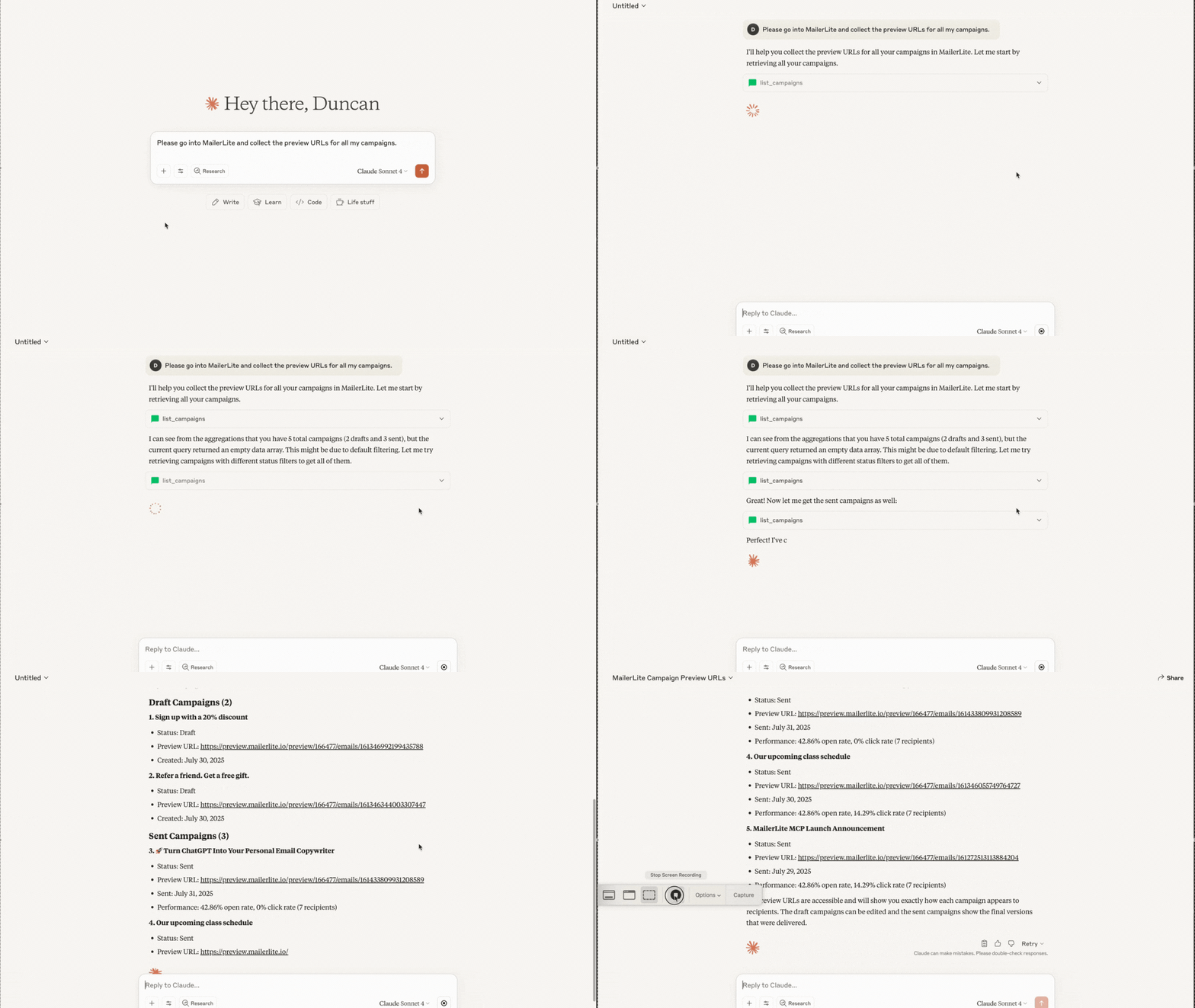
You could also adapt this prompt to get the previews for:
Your most recent campaign
Draft campaigns
Campaigns with a 40%+ open rate
Campaigns that use a particular keyword in the title
All emails in a particular automation
15. Translate a campaign into another language
Get a head start on translating your campaign by asking your AI tool to check your latest sends and translate all the text. Then ask the tool to set up a new campaign so you can add the translated text via the builder in MailerLite.
16. Double-check campaigns before sending
There are so many things to check when sending an email, getting it all right can feel like a lot of pressure, especially if you have a large list.
This tip, also suggested by our email lifecycle manager Risper, helps by asking the AI tool to check your campaigns before sending them.
She tells the AI to double-check the link URLs, personalization tags, recipients and whether everything lines up with the original brief.
Advanced email MCP workflows
So far we’ve focused on things that the MailerLite email MCP can do on its own. But some of the most powerful use cases come when you connect other platforms to your AI tool, use the scheduled tasks option in your AI tool, or even both.
Here are some MCP use cases that cover these ideas.
Scheduled tasks are an option available in both Claude and ChatGPT that runs a particular task on a set schedule. You just have to set it up once, and the tool will run the task at the time you chose.
17. Set up weekly analytics task
Gerrit van den Berg, founder of Hidden Holland, set up a scheduled task to create a weekly email marketing report that provides an overview of his performance from the previous week and then deliver it to Slack on Monday morning.
This gives him an overview of the previous week’s email marketing performance without him ever needing to dig through his data.
18. Repurpose emails into social media posts
Creating content for multiple platforms can take a lot of time. This prompt lets you turn any of your recent email campaigns into a post you can share on social media.
Just set up a weekly scheduled task to write posts based on any newsletters sent the previous week. If you use a social media scheduling tool that also has an MCP server, such as Buffer, you could even use the task to upload the post to the tool.
19. Create email mockups in Figma
At MailerLite, we sometimes create email mockups in Figma before building the designs in our drag-and-drop builder.
Email lifecycle manager Risper details what she wants from the campaign in Claude, which then builds the design in Figma; sometimes even creating multiple designs at the same time.
And since Figma has our brand styles saved, it can quickly create on-brand designs for every use case. Risper can then jump into MailerLite to quickly recreate the design in our drag-and-drop builder.
How to set up your email marketing MCP server (it’s easy)
You can connect MailerLite to your AI tool using one of our official apps, or by setting up the MCP server manually.
Using our official apps is the easiest way, and we have options for both Claude and ChatGPT.
To get set up with Claude, hit the + button in any chat, click Connectors, Browse connectors, search for MailerLite, and then follow the steps to authorize your account.
To get set up with ChatGPT, click the + button in a chat window, select Connectors, then Browse connectors, search for MailerLite, and follow the instructions.
You can also manually connect MailerLite with any AI tool that supports MCP, including VS Code and Cursor. The exact setup method varies depending on the tool, but you typically have to head to the MCP settings menu, add the address of MailerLite’s MCP server (https://mcp.mailerlite.com/mcp), hit Connect, and then follow the steps to authenticate your MailerLite account. See full instructions for setting up MailerLite’s MCP server in this guide.
Yes, you can use MailerLite’s MCP server for free. It’s available on all plans, including our free one. At the time of writing, both Claude and ChatGPT allow you to connect to apps on the free plan, too.
Now over to you!
These are some of the most exciting MCP server use cases that we found. We can’t wait for you to try them out.
We’d also love to hear any prompts that you have found useful. Let us know in the comments!
Try email marketing MCP for free
MailerLite’s MCP server is available on all our plans, including free. Try it out by signing up for a free trial and then connect to your AI tool of choice.