The numbers are in. The best time to send email newsletters in 2026 is…

 CEO, Indre, and SEO team lead, Paulius, testing email send times together
What is the best time to send emails in 2026? This is one of the most common questions we get, so we dove into our own data to shed some light and find answers.
With that said, is there a time when your subscribers are perfectly primed and ready to receive your email? And if this ‘perfect time’ does exist, wouldn’t everyone be sending their newsletters at exactly the same time, defeating the purpose of trying to stand out in the inbox?
Let’s see exactly what the data says so you can make informed decisions about when to best show up in your subscribers’ inboxes. In this article, we’ll cover:
The best day to send emails
The best time of day to send emails based on open rates
The best time of day to send emails based on click rates
The best day to send emails based on your industry
What email marketing tools and strategies you can use to improve your open rates
But before we get into all of that, how did we come to these conclusions?
Our data: How we gathered it and what it means
We analyzed over 2 million email marketing campaigns (2,138,817 to be exact!) sent through MailerLite from the US, UK, Australia, and Canada between December 2024 and November 2025.
The aim of the study was to identify the optimum times to send emails in 2026 based on user engagement metrics of the previous 12 months. The analysis includes insights into the best days and times to send email campaigns across various countries and industries.
Key Metrics Explained
Sent campaigns: Number of campaigns successfully sent to recipients
Total opens: Total number of emails opened by recipients
Total open rate: Proportion of total opens to emails sent across all campaigns (weighted average)
Average open rate: Average open rate across individual campaigns (equal weight)
Average click rate: Average click rate across individual campaigns (equal weight)
Now let’s jump right into the key insights we gathered from this data.

TL;DR: What does the data say about the best time to send an email campaign?
We wanted to use our data to find out which day marketers typically send email campaigns, which day generates the highest open and click rates, and what time of day sees the highest number of opens and clicks.
Here’s a summary of what we found:
Which day of the week is everyone sending their campaigns?
Email marketers favor Thursday (closely followed by Friday and Wednesday) for sending out their campaigns. The email campaign sending activity is at its peak during these 3 days.
Which day of the week generates the most opens and clicks?
Friday generates the highest average open rate (49.72%), closely followed by Monday (49.44%)
Friday generates the highest average click rate (8.09%), followed by Tuesday (7.84%)
What time of the day generates the most opens and clicks?
During most weekdays, the highest open rates fall between 8 AM and 11 AM local time, indicating a shift toward morning inbox clearing
The highest click rates fall much later, between 8 PM and 9 PM, suggesting audiences save action-oriented emails for after-hours engagement
General summary of findings
Open vs click timing differs on weekdays, except Friday: Opens peak weekday mornings (8 -11 AM), and clicks peak weekday evenings (6 - 9 PM), except on Thursdays when clicks peak at 8 AM
Friday anomaly: The only day where best open (6 PM) and click (6 PM) times coincide, likely due to the end-of-week engagement pattern
Weekend performance: Saturday and Sunday opens and clicks are similar to weekday performance, with opens peaking at 9 AM and clicks at 8 PM, but keep in mind that the lowest volumes of emails are sent on these two days
Audience behavior varies: Subscribers to institution emails prioritize early morning action (8 AM), while creators see peak engagement in the late evening (9 PM)
Action matters most: Focusing campaigns on the time your audience is ready to click (evening) is generally more effective than simply aiming for the highest open rate (morning)
But as you’ll read in this article, it’s important to base your sending times on your specific subscribers' preferences. And when in doubt, test and learn!
What’s the best time to send an email, based on the day, open rates, and click rates?
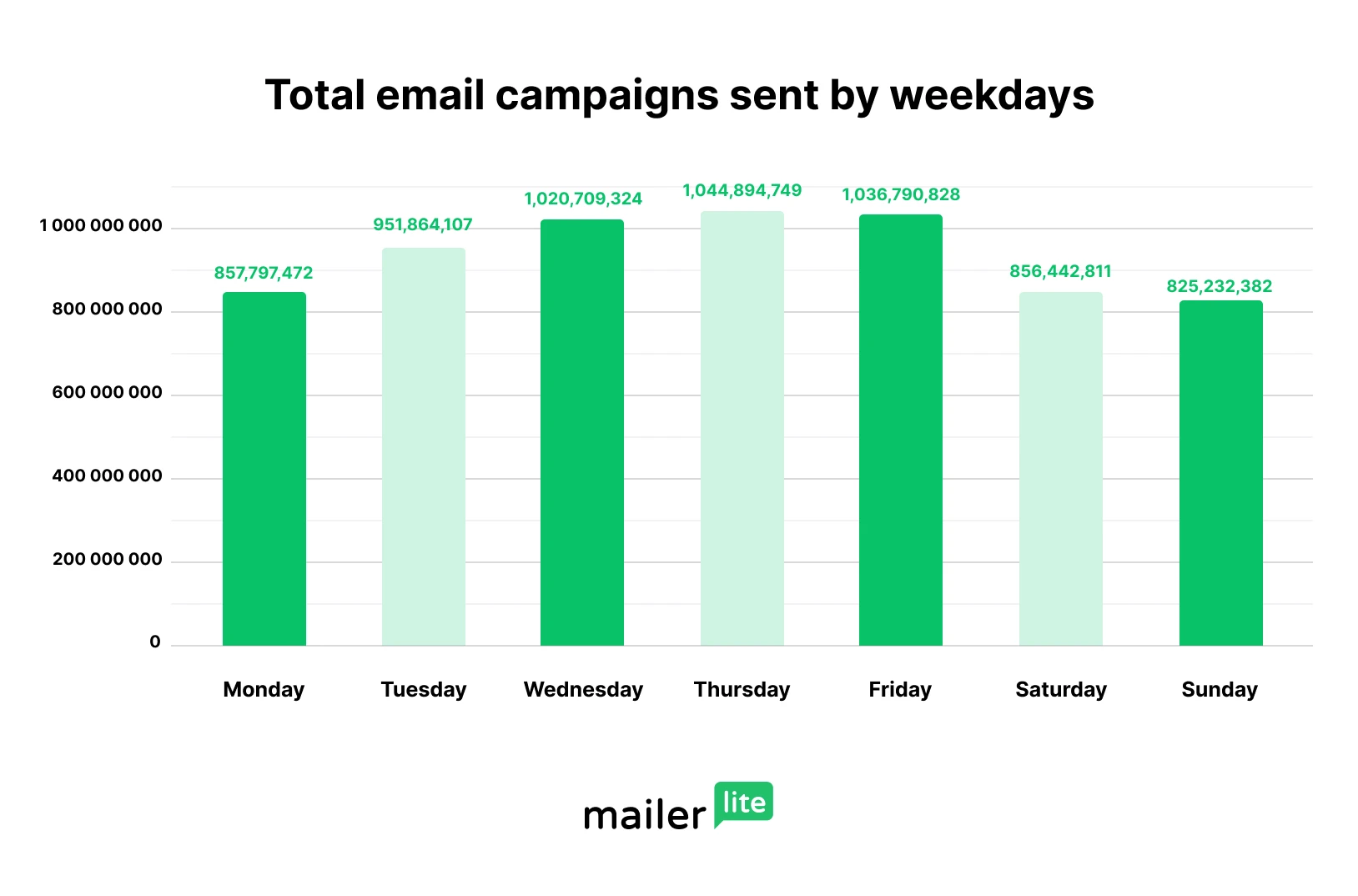
Want to know when your fellow marketers are sending out their campaigns? First, here's a look at how many campaigns were sent on each day of the week:
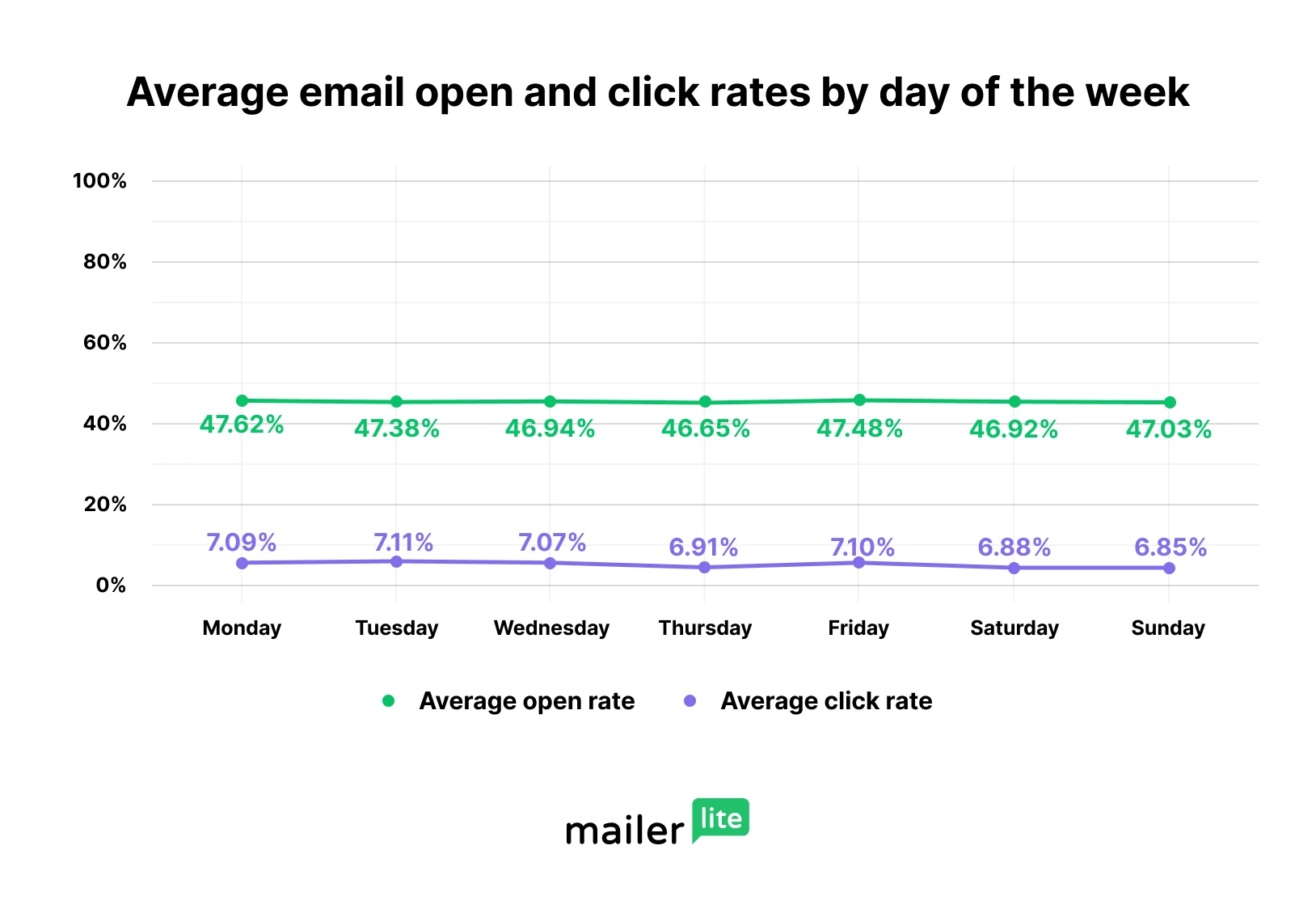
Next, let's see the average open and click rates by day of the week:
What the overall data says about the week:
As we noticed in the previous section, the inbox is most crowded during the mid-to-late week. Thursday and Friday see the highest volume of campaigns sent, while Wednesday is the next closest. Predictably, Sunday has the lowest volume
Open rates are surprisingly consistent across the entire week, generally hovering between 46.5% and 47.5%. Monday and Friday slightly edge out the rest of the week for initial opens
Weekdays clearly dominate for action. Tuesday and Friday deliver the highest average click rates, closely followed by Monday. This confirms that action-oriented campaigns perform best during the work week, even though people still open their emails on the weekend
Best send time by day (open rate):
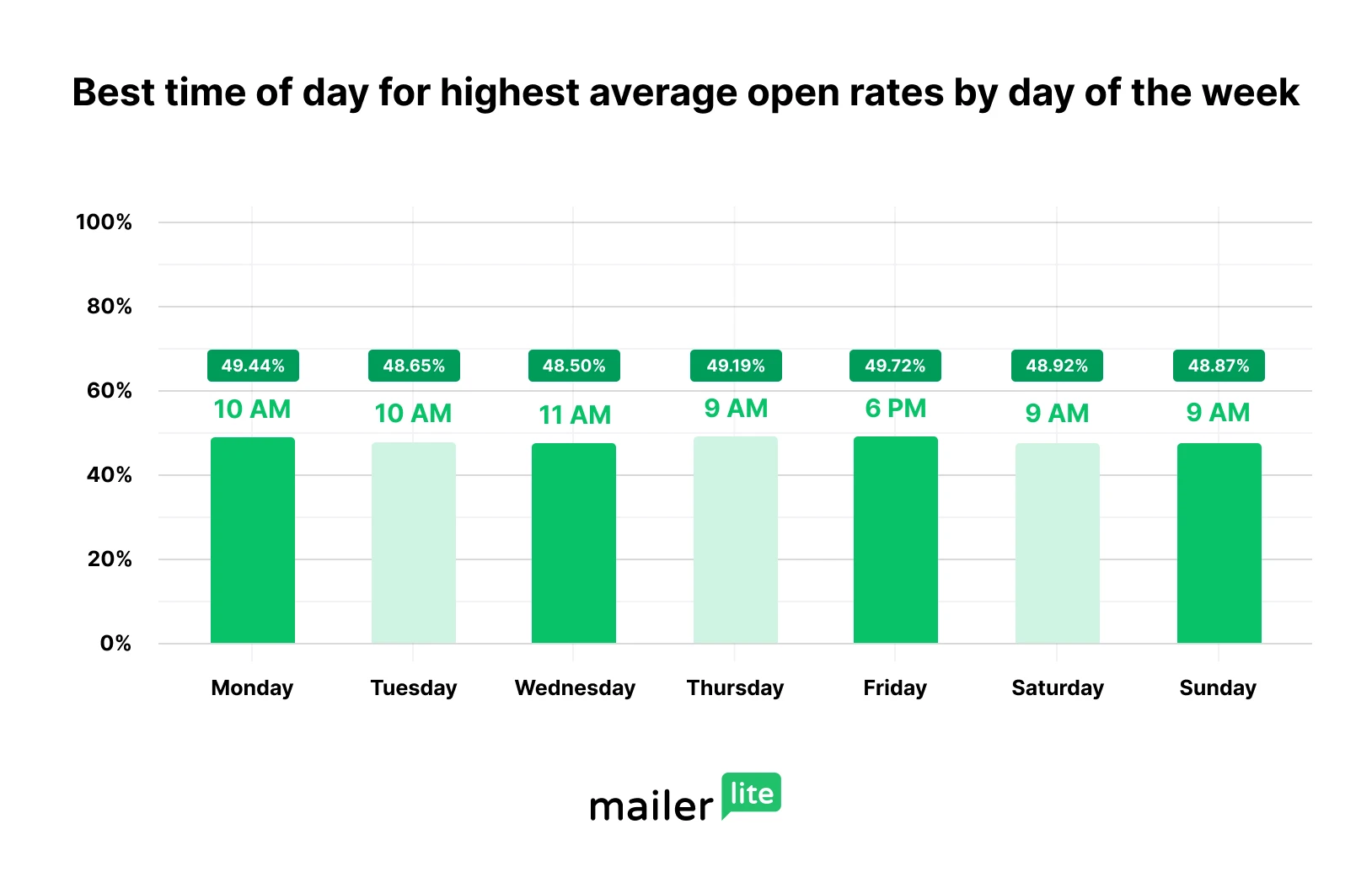
Now let's take a look at the highest open rate and time when this happens for each day of the week:
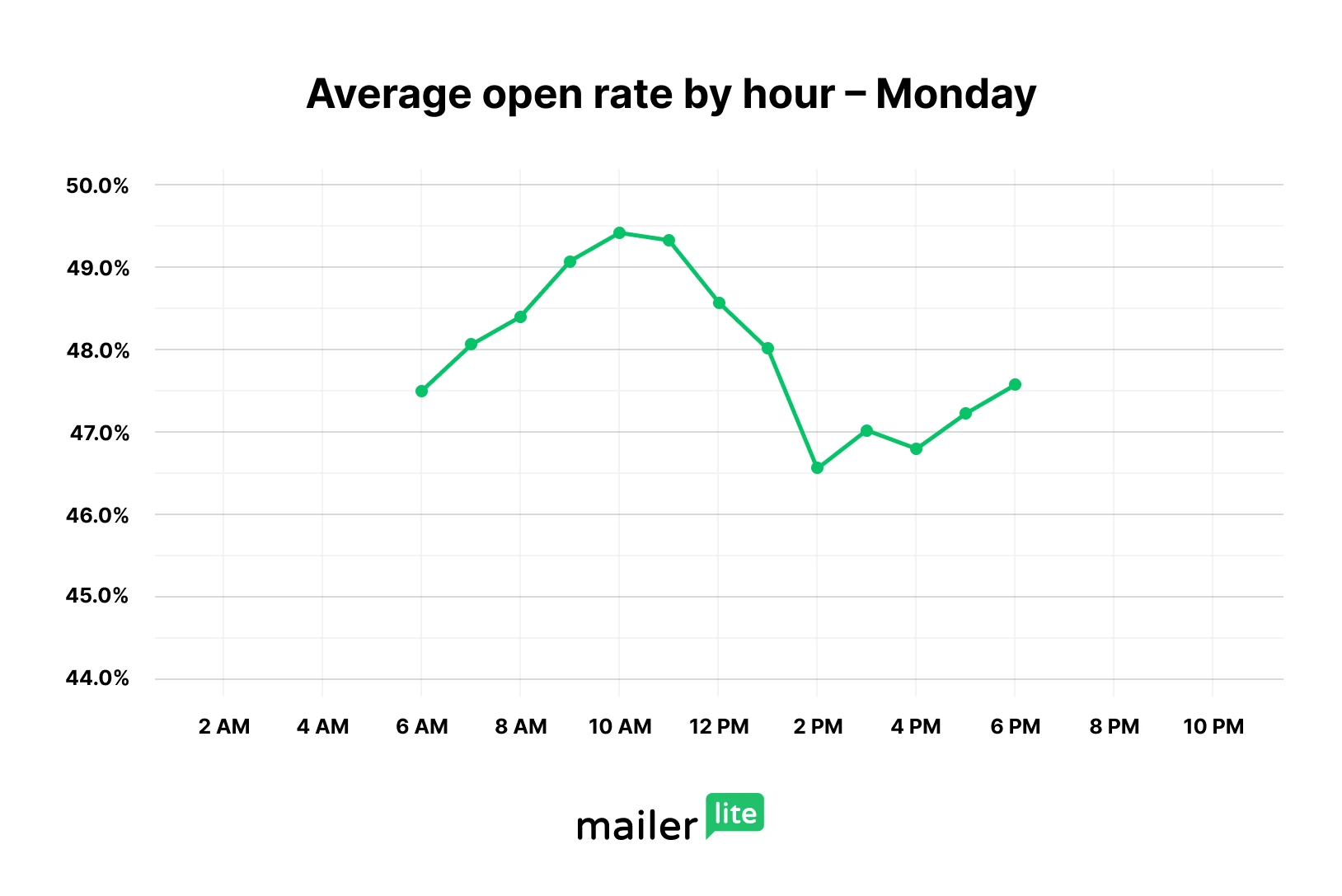
Monday: 10 AM with an average open rate of 49.4%
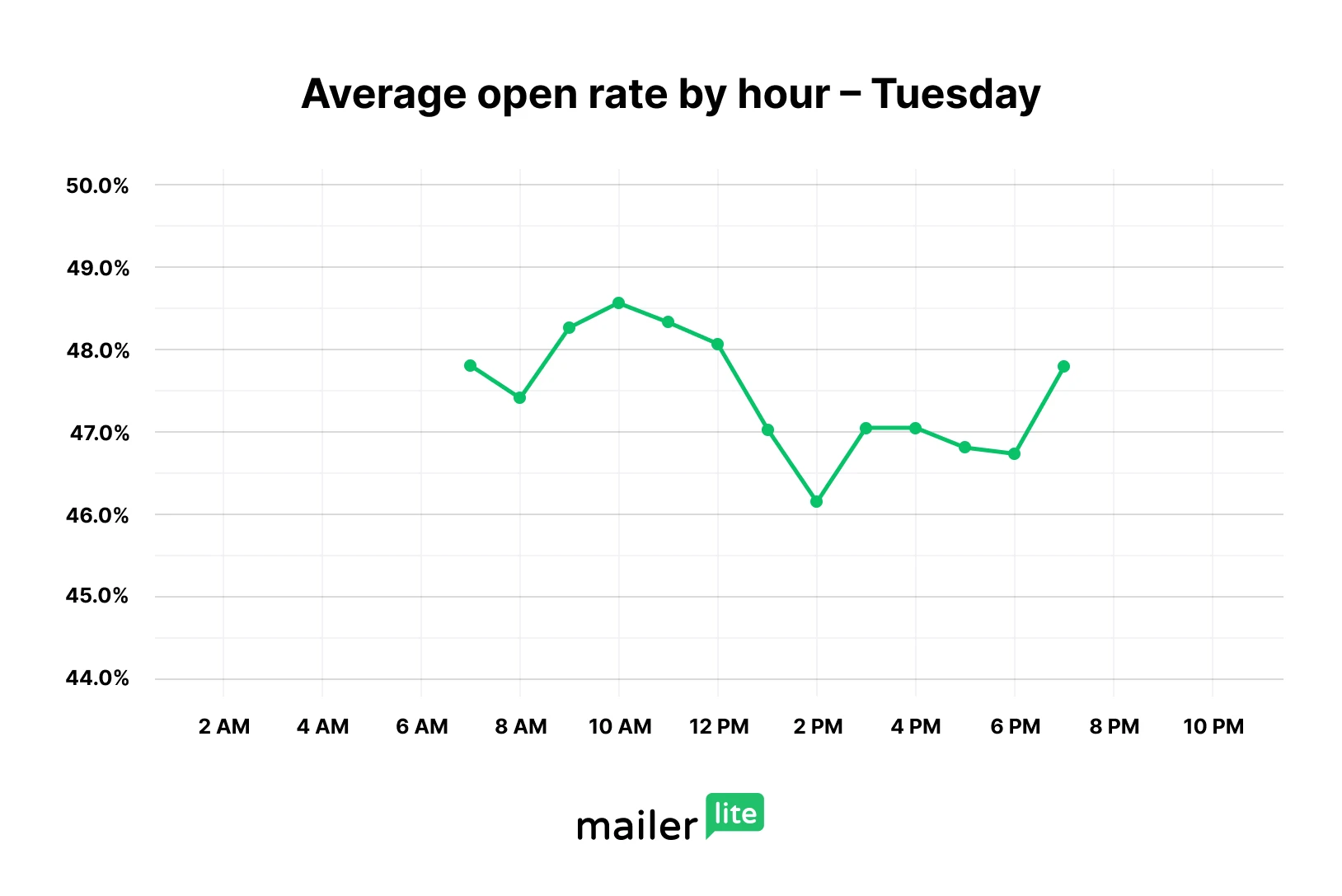
Tuesday: 10 AM with an average open rate of 48.7%
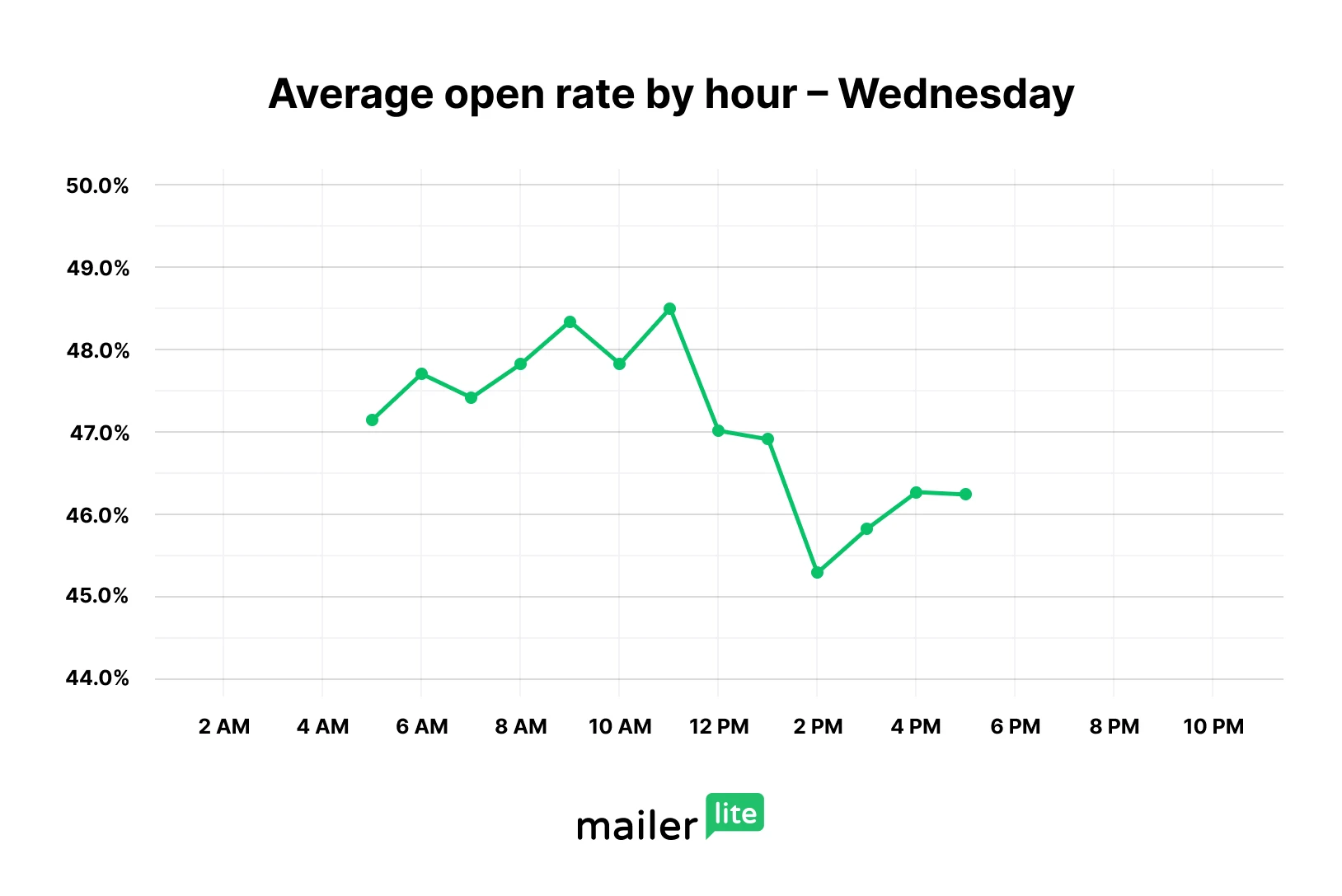
Wednesday: 11 AM with an average open rate of 48.5%
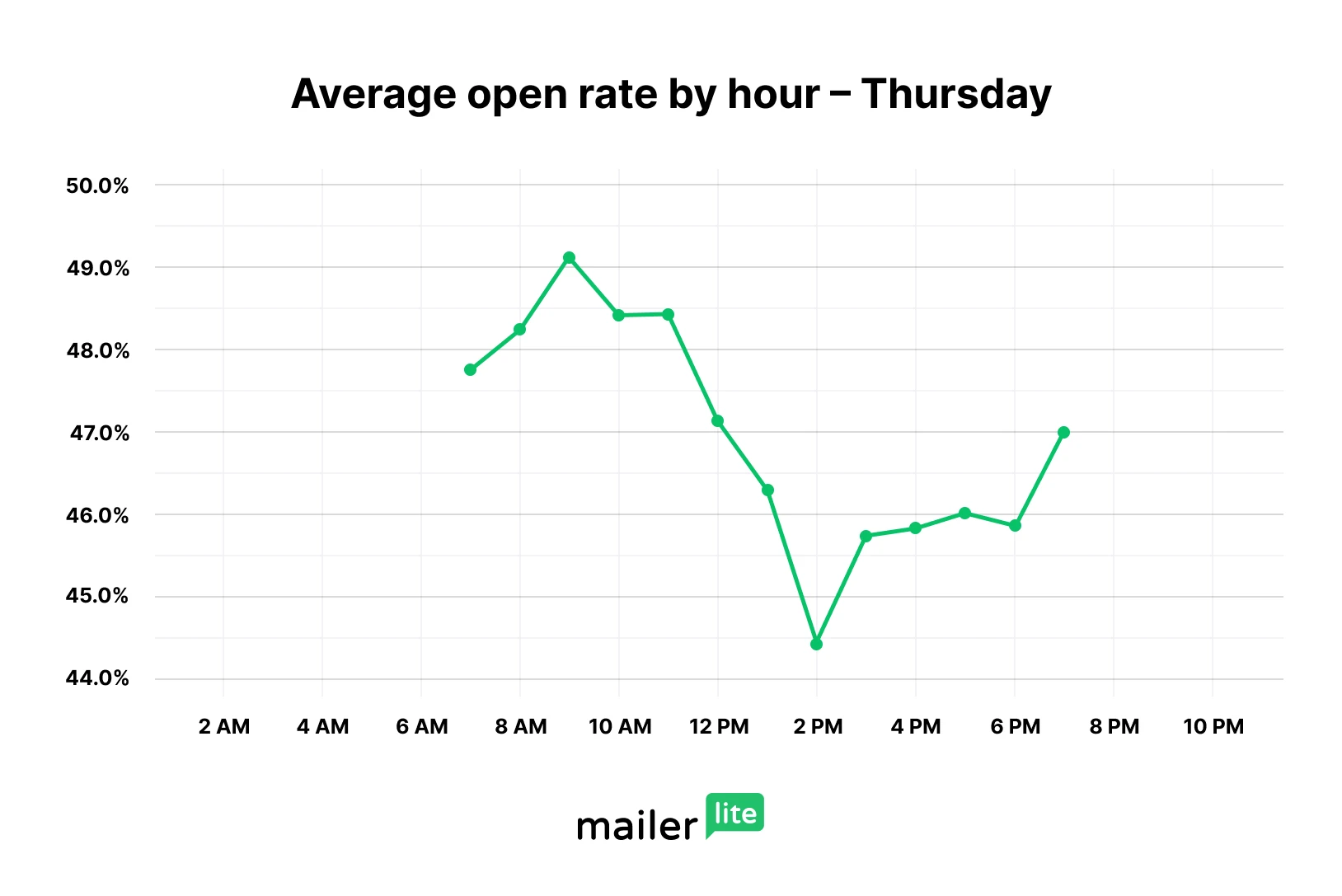
Thursday: 9 AM with an average open rate of 49.2%
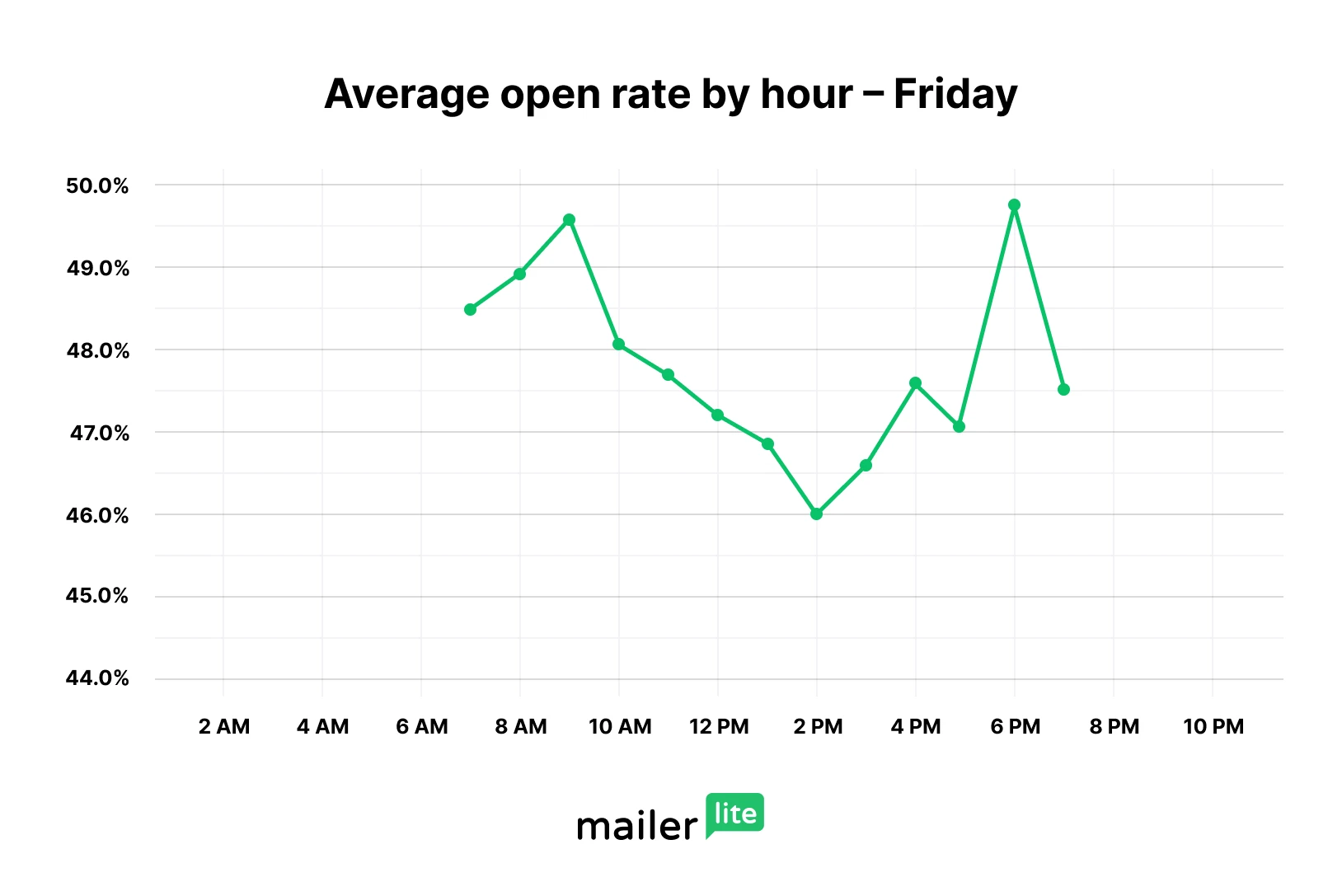
Friday: 6 PM with an average open rate of 49.7%
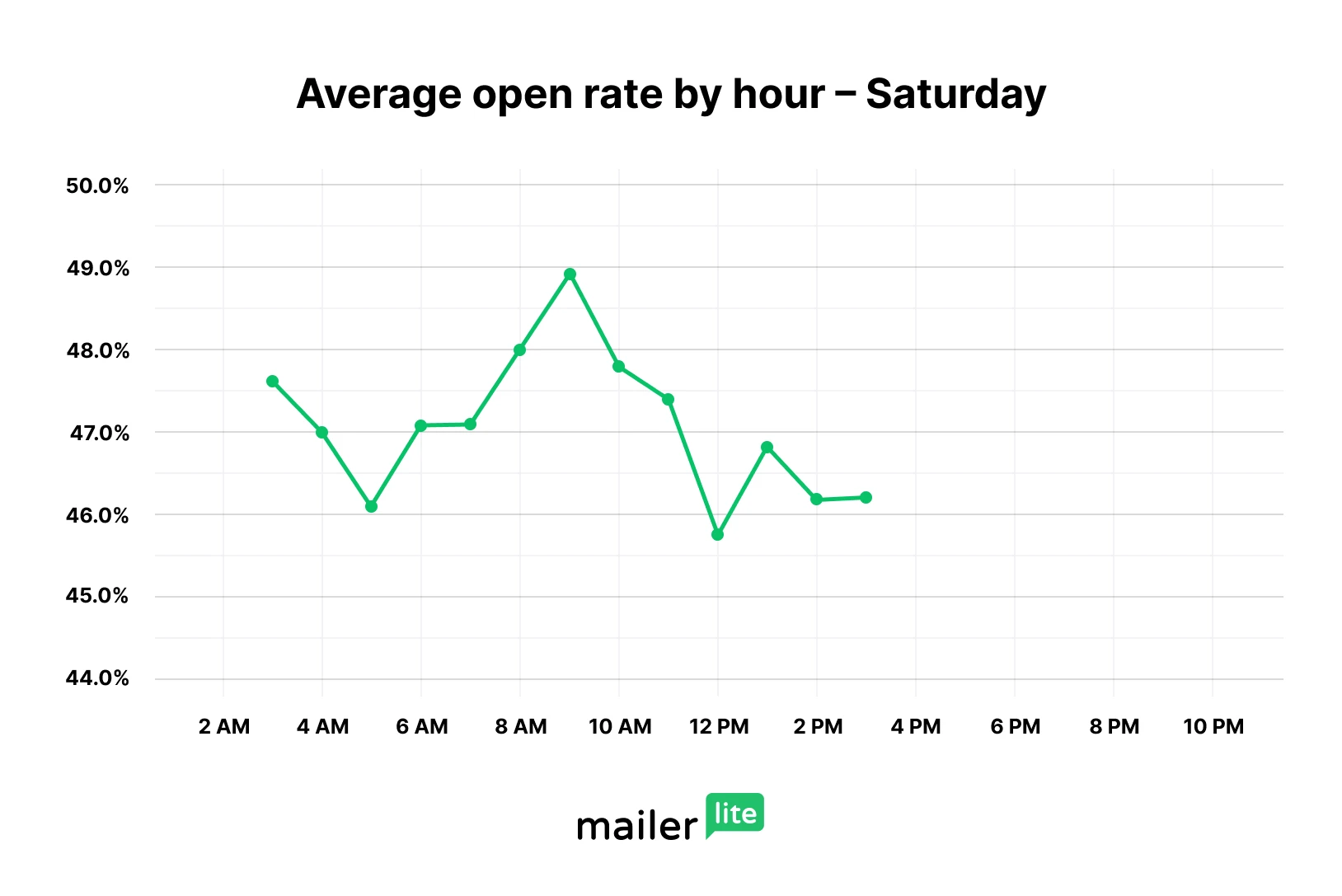
Saturday: 9 AM with an average open rate of 48.9%
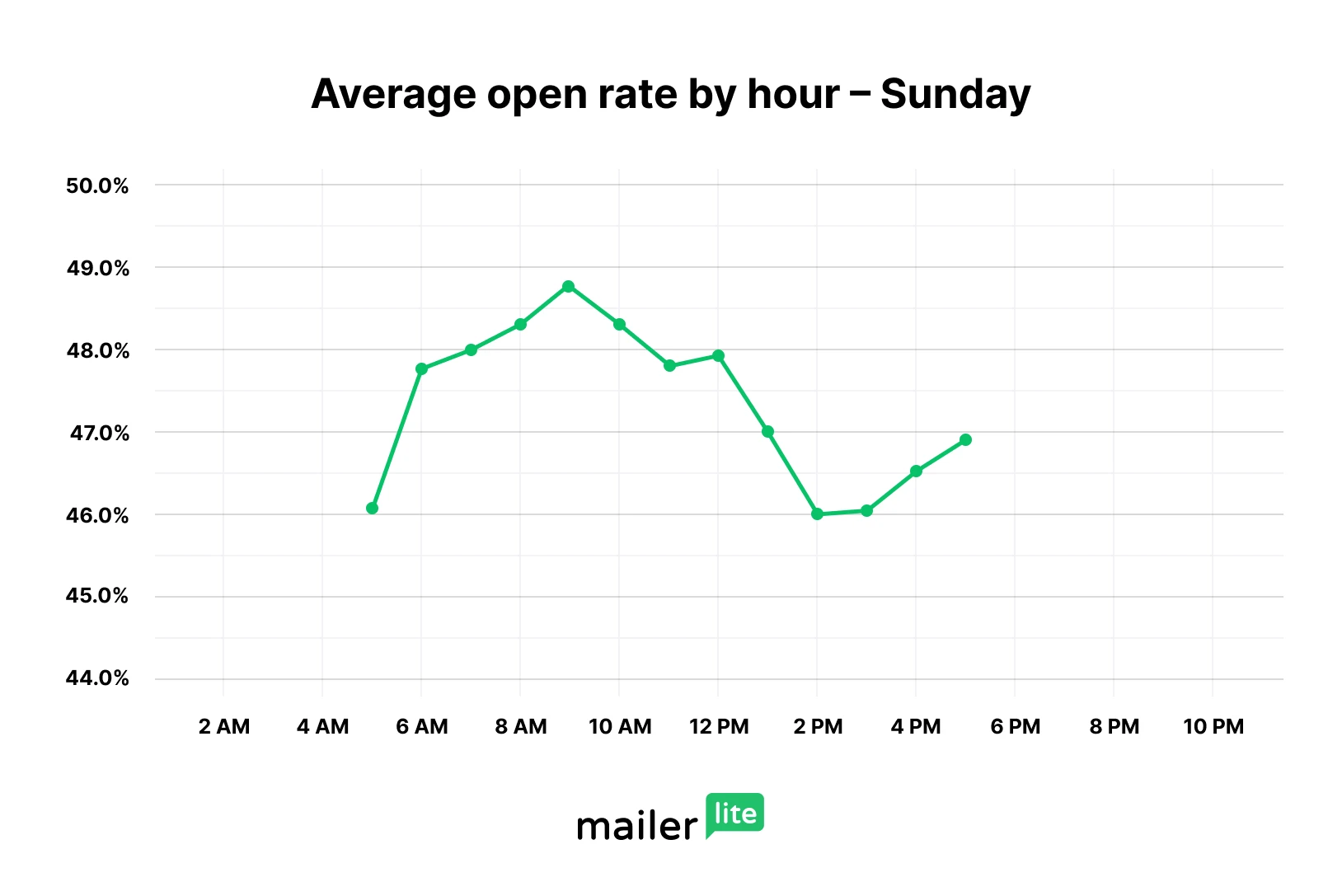
Sunday: 9 AM with an average open rate of 48.9%
Like last year, open rates are still pretty consistent across the week, hovering in that high 48% to 49% range during the peak times.
The highest peak average open rate of the week belongs to Friday at 6 PM (49.7%). Perhaps people are done with their official work tasks and are finally turning their attention to their personal inboxes and newsletters.
Not sure what time of day works for your audiences? Use MailerLite’s Smart sending feature to analyze your subscribers’ behavior and automatically deliver emails at the optimal time.
Smart sending is an advanced tool that uses historical data to determine the best send time for each subscriber. It continues to learn and adapt to your readers’ habits.
When you click to send with Smarting sending, your campaign is automatically broken down into batches and each subscriber receives the newsletter at the time they’re most likely to open and interact with it. No guesswork based on other people’s data. Just results driven by your very own audience.
Use smart sending and see your engagement shoot up!
MailerLite’s Smart sending analyzes your subscribers’ behavior and automatically deliver emails at the optimal time helping you get a massive boost in both open and click rates.
Best time to send an email on a Monday
According to the data, 10 AM is the peak time when people open their emails on a Monday with an average open rate of 49.4% that stays quite consistent right up until 1 PM. The open rates again pick up from 7 PM onwards when people are likely done with their jobs and checking their emails.
This is likely when your subscribers are starting their work week and having cleared out their most urgent emails, are ready to focus on and open other useful messages before lunch.
Best time to send an email on a Tuesday
On Tuesdays, too, we find the same pattern of open rates hovering between 47% and 48% from 7 AM to 1 PM, with the peak open rate at 10 AM (48.7%). The Tuesday morning pattern shows that people are consistently checking and opening emails throughout their focused, high-productivity hours before lunch, peaking once they settle into their work.
In the evenings, we see open rates rising around 6 PM onwards likely because people have finished work, and taking care of their personal emails before the day ends.
Best time to send an email on a Wednesday
On Wednesdays, open rates peak a little later at 11 AM (48.5%). But like the previous 2 days, Wednesday also follows the same pattern of high open rates between 6 AM to 11 AM, post which it dips a little.
Best time to send an email on a Thursday
Thursday sees its peak open hour at 9 AM with the open rate crossing 49% once again after Monday and reaching 49.6%. Thursday also sees a surge in open rates (between 48% and 49% ) between 7 AM to 11 AM before gradually slowing down to reach its lowest at 2 PM (oh, the post lunch slump!) before slowly picking up.
Best time to send an email on a Friday
Thank God it's Friday! Not only are office workers saying that, but as an email marketer, you should, too! Friday at 9 AM takes the runner-up prize with the second highest open rate of the week at 49.6%. It reaches the highest open rate of the week at 6 PM (49.7%).
This makes Friday the only day where the open rate reaches its highest in the evening. Impressively, even when you compare its 9 AM rate to the morning open rates of the rest of the weekdays, Friday still comes out on top! 👑
This trend suggests that on Friday mornings, your subscribers are focused on clearing their inboxes to finish the week strong. Later, the 6 PM peak happens probably because they are officially done for the week and are finally looking through their emails for weekend reading, planning, or personal follow-up.
Best time to send an email on a Saturday
The best time to send emails on a Saturday is 9 AM (48.9%), but for the rest of the day, the activity slows down a bit compared to the weekdays. Also, keep in mind that the total campaigns sent is the second lowest on Saturday with the lowest being Sunday.
Best time to send an email on a Sunday
Like Saturday, the best time to send emails on a Sunday is also at 9 AM (48.9%). But unlike Saturdays, we see the open rates consistently hovering between 48% and 49% from 6 AM all the way to 12 PM, which suggests a rise in morning activity.
This likely happens because subscribers are using the quiet weekend time to check communications, plan for the upcoming work week, or catch up on content they missed.
If you're not sure about whether or not to send on the weekend, the simplest way to find out if it’s the right move is to run some tests and experiment.
Best send time by day (click rate):
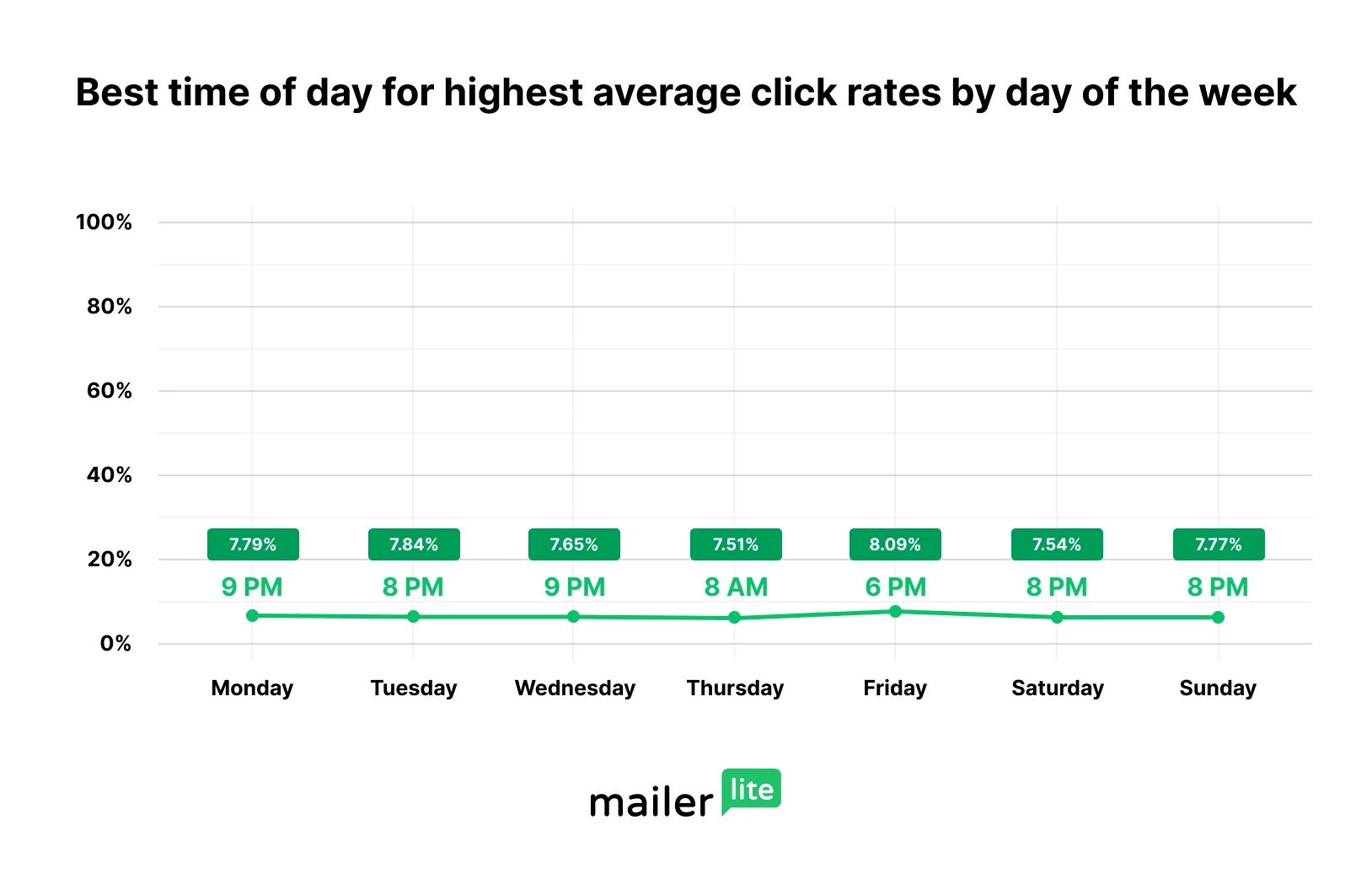
The click rate is where the story gets really interesting for email marketers. Our data shows a gap between when people read your email (opens) and when they act on it (clicks).
For most of the week, the open rate peaks in the morning (8 AM – 11 AM), but the highest click rates are seen much, much later: between 8 PM and 9 PM, except on Friday (6 PM) and Thursday (8 AM).
This could mean that subscribers are skimming their inbox on their morning commute or at their desk, but they don't have the mental space to click a link, browse a store, or sign up for a webinar until they're relaxed in the evening.
This morning tendency extends into the weekend, with Saturday and Sunday seeing their peak open rates around 9 AM. It seems that even while relaxing, the instinct to check the inbox is a key part of the morning ritual.
The only time the open rate and click rate align is the perfect storm of Friday at 6 PM, which offers the highest average open rate (49.7%) and click rate (8.09%) of the week.
This suggests that, perhaps, by the time Friday evening rolls around, your audience is primed, relaxed, and ready to engage and take action before starting their weekend.
While we can now confidently identify the 9 AM–11 AM window as the best time to ensure your email is opened, remember the most important finding from our data: the optimal send time for opens isn't the best time for clicks.
The morning hours are perfect for visibility
The evening hours (8 PM – 9 PM) are perfect for action
If your email's primary goal is to drive traffic or sales, you may choose to send in the late afternoon (to hit the evening click window), even if it sacrifices a few percentage points on the initial open rate.
The best time to send an email by industry
Now, let's check out the sending trends across specific industries. We collated this data by filtering it by the various industry types associated with our customers’ accounts.
The categories include:
Creators (authors, course creators, bloggers, YouTubers, etc.)
Entrepreneurs and SMBs (local businesses, service providers, e-commerce stores, etc.)
Institutions (higher ed, government, non-profit, etc.)
E-commerce businesses
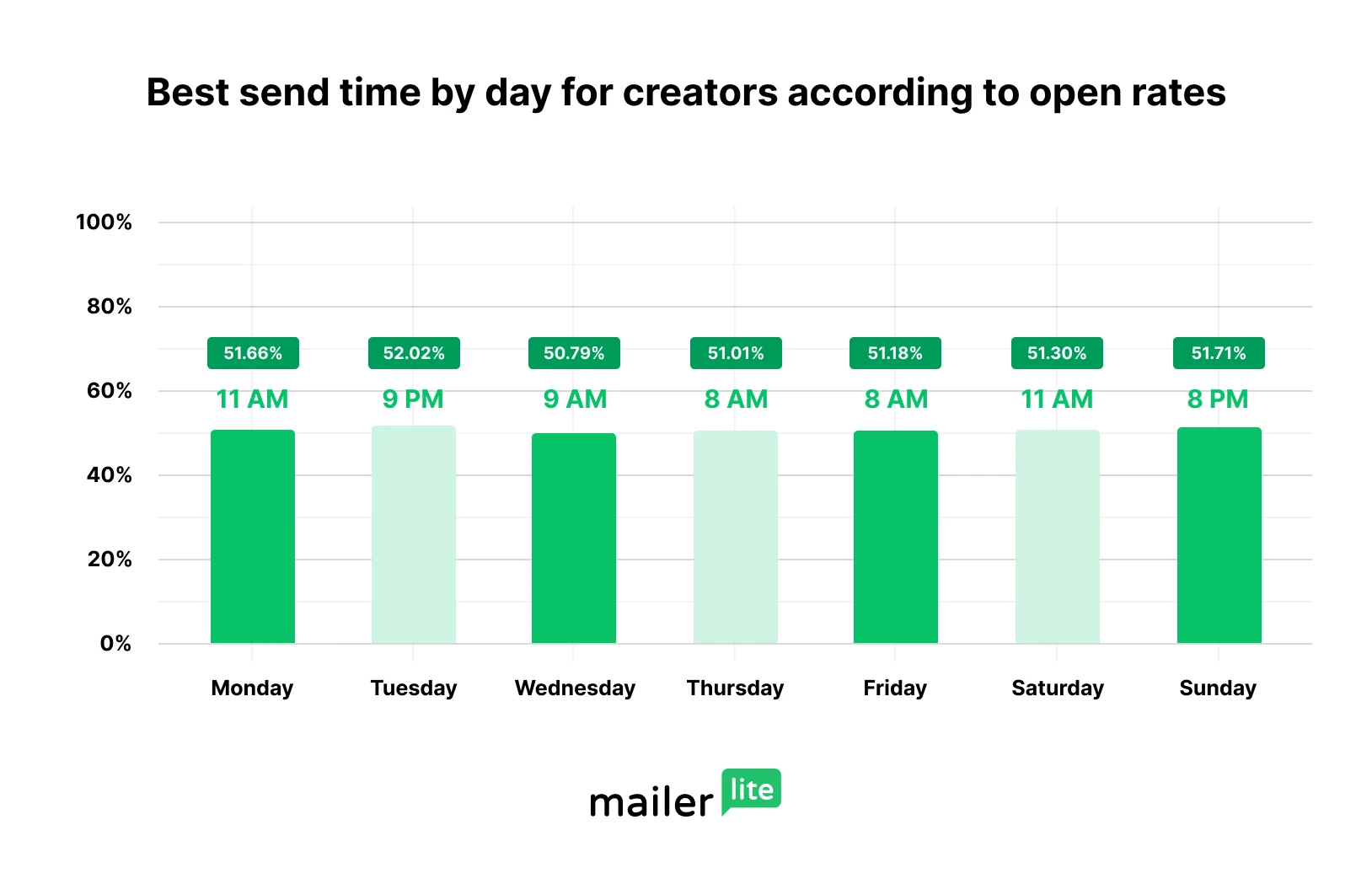
The best day for creators to send an email campaign is…
The creator economy is unique: the content is often more personal, which translates directly into higher engagement. We found that creator campaigns consistently achieve some of the highest open and click rates across all industries, reinforcing the value of that personal touch.
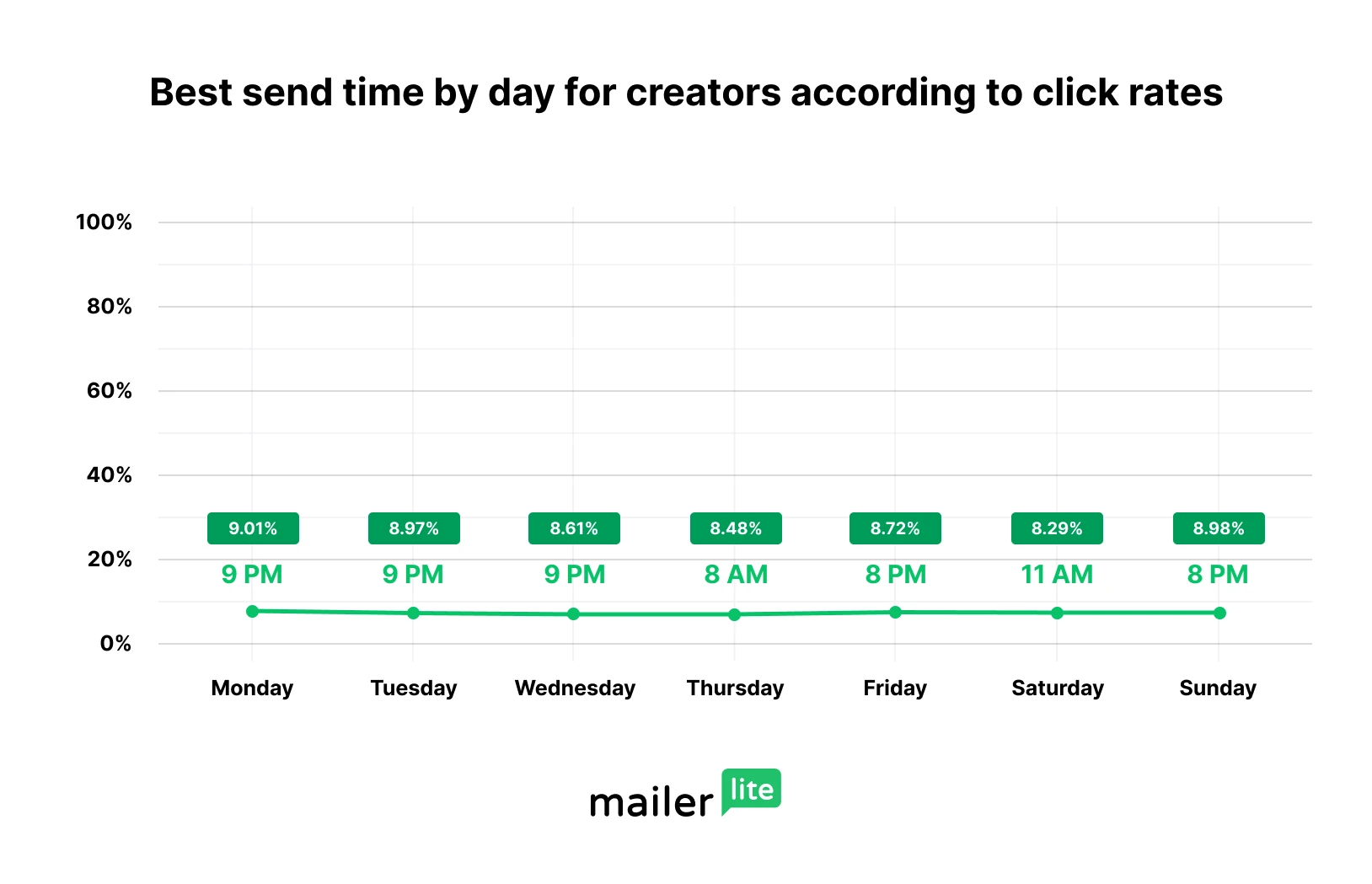
For creators, the key takeaway is simple: Action happens in the evening.
While the peak open hours are slightly scattered—from 8 AM on Fridays to 9 PM on Tuesdays—your audience reserves their highest engagement for the end of the day on most days.
The peak click rate for the entire week belongs to Monday at 9 PM (9.01%), followed closely by Tuesday at 9 PM (8.97%) and Sunday at 8 PM (8.98%). If your goal is conversions, link clicks, or purchases, the 9 PM window is your primary target.
Forget trying to fight the busy midday inbox rush. Your audience treats your emails like premium, dedicated viewing. You have two clear options for success:
Send your emails to land near 8 PM or 9 PM on weekdays (especially Monday/Tuesday) to hit the highest click rates
Sunday evening at 8 PM provides impressive click rates and high alignment, making it an excellent, low-competition opportunity for high-value sends
The best day for entrepreneurs and SMBs to send an email campaign is…
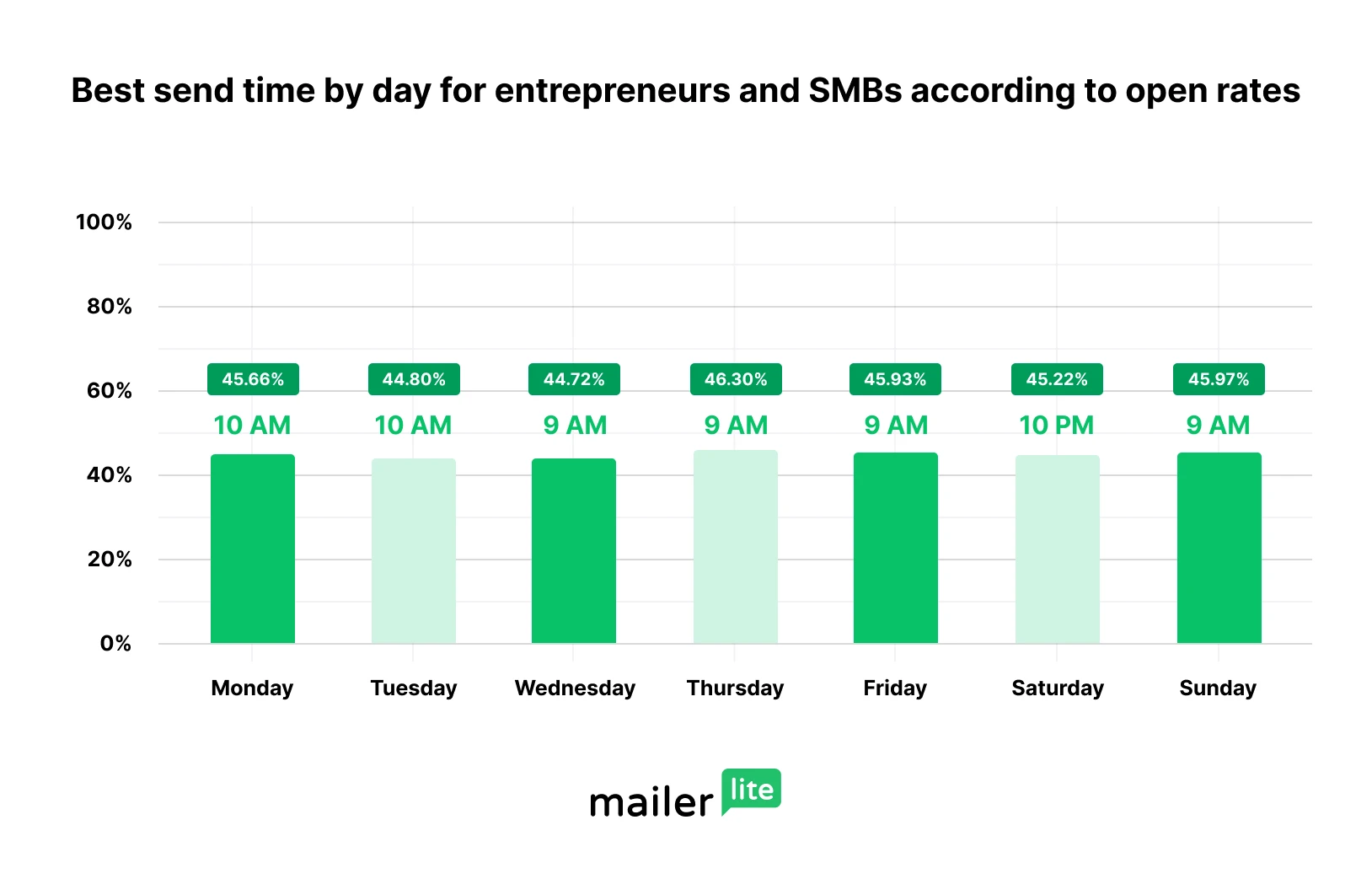
For entrepreneurs and SMBs, a morning send helps get your email opened. Thursday at 9 AM delivers the highest average open rate of the week (46.3%).
The majority of weekdays, as well as Sunday, see peak open rates consistently focused around 9 AM or 10 AM. Saturday is the only weekday with a significantly late open peak, hitting its highest open rate (OR) at 10 PM (45.2%).
Going by the click rates, the SMB audience takes action at non-standard hours (early mornings and late nights are common for this segment).
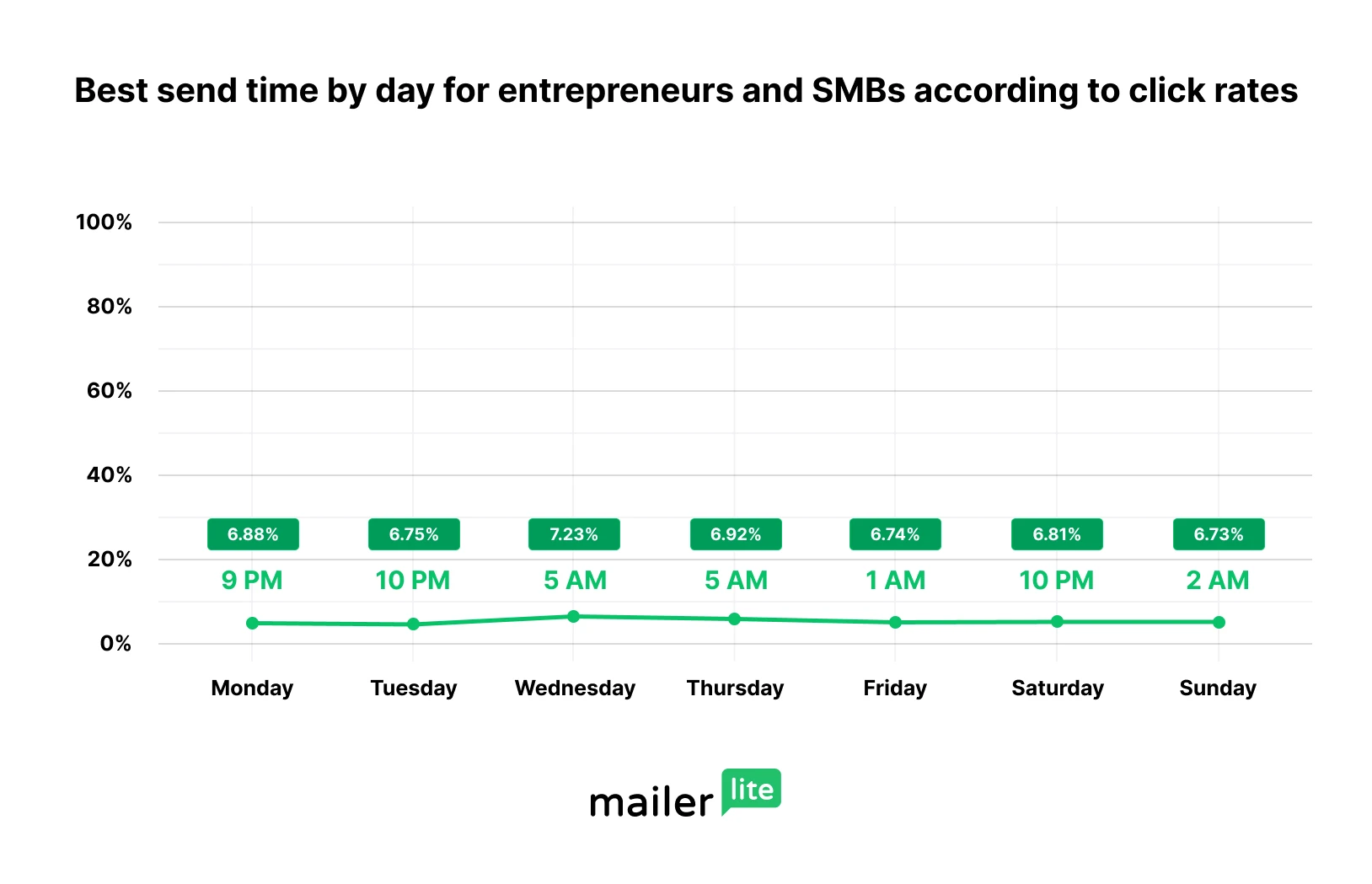
Your strategy must focus on catching them before the noise of the business day starts:
If conversions are your goal, consider scheduling your most important emails for Wednesday or Thursday, in the early morning, to hit the peak action window
If you’re prioritizing simple visibility and brand awareness, Thursday 9 AM is your safest bet for high open volume
Due to the unusual click patterns, you should be aggressive in testing extremely early send times and late evenings, as these are the time for highest clicks
The best day for institutions to send an email campaign is...
This audience is composed of students, constituents, and members who need to read the email to receive important information, leading to exceptionally high open rates (routinely over 56%) and the highest click rates we observed in the entire study (peaking at 12.26%).
For institutions, the key is hitting the audience at the start of their day. While morning is best, the data also reveals that institutions are catching attention during the commute or evening hours on certain days.
The highest open rate on a weekday for institutions come on Friday at 7 AM (58.4%).
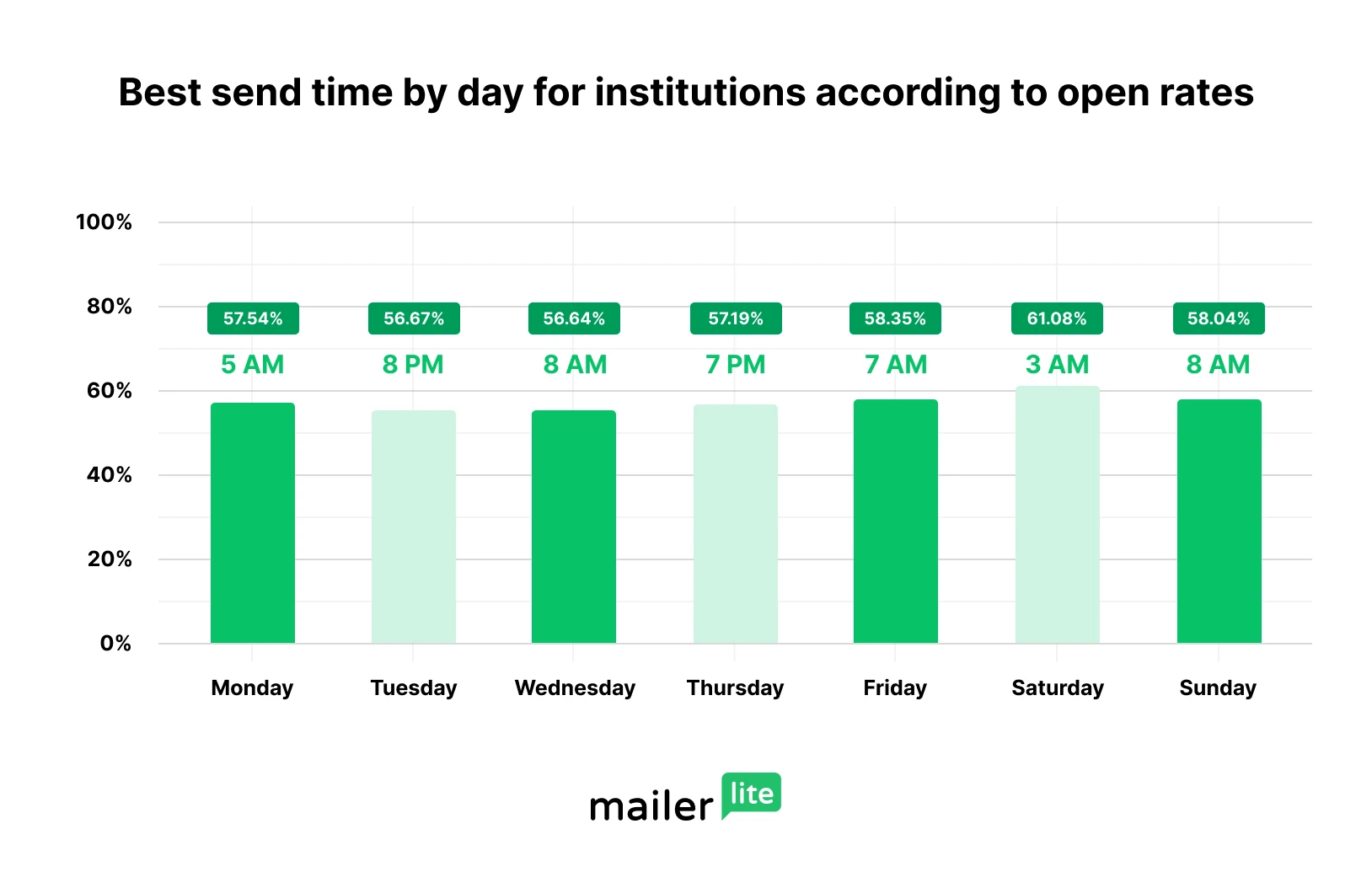
The peak action time of the entire week is Friday at 8 AM, which delivers an average click rate of 12.26%. The audience opens at 7 AM (58.35% OR) and immediately takes action at 8 AM.
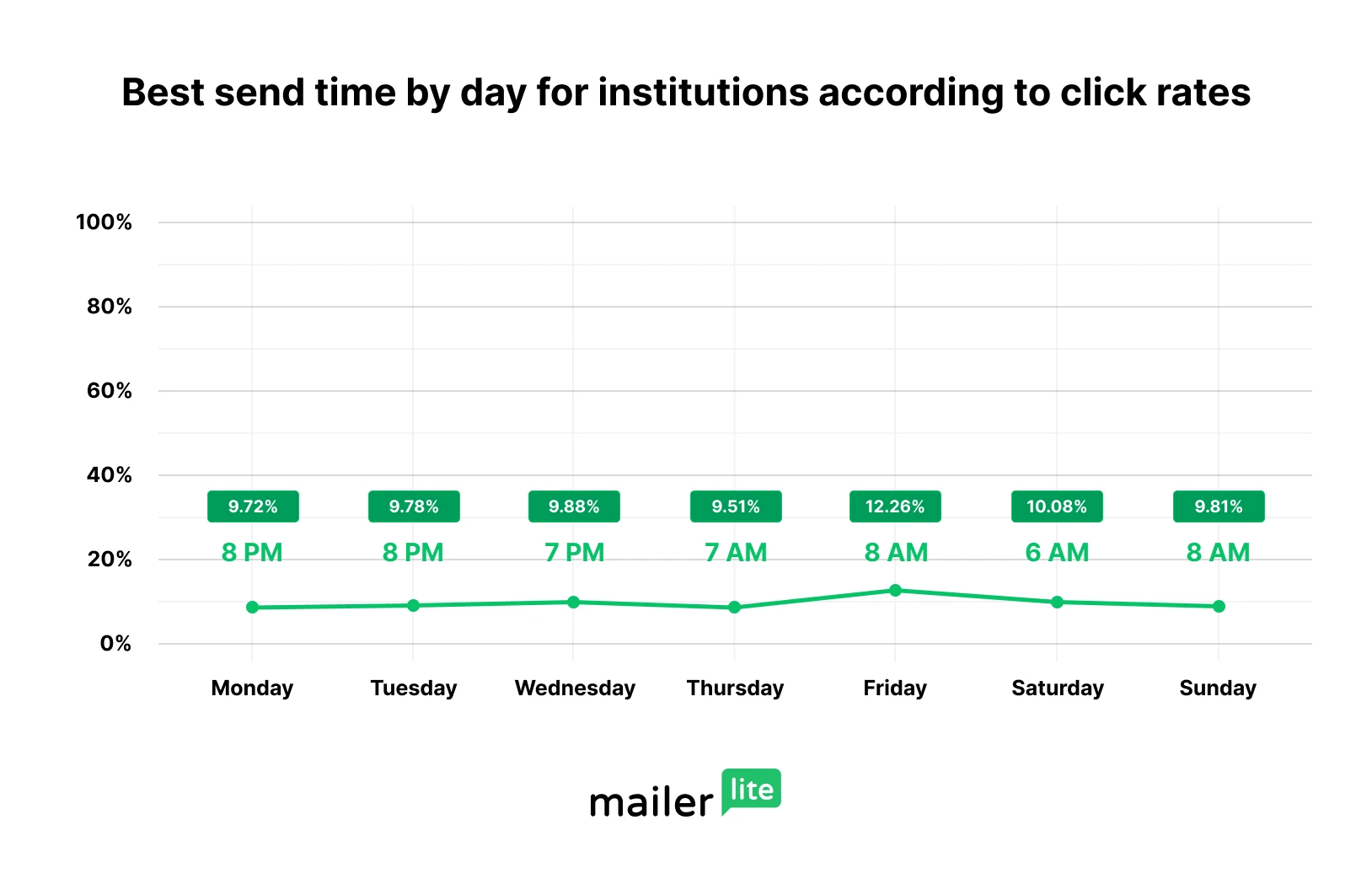
Sunday at 8 AM also shows perfect alignment between high opens (58.04%) and high clicks (9.81%). Do consider though, that the lowest volume of emails are sent on Sundays. You could use this window for important weekend announcements (e.g., event reminders, deadlines, and so on).
Your audience treats your emails as mandatory reading. Your strategy should be built around urgency and deadlines.
Schedule your most important, action-driven emails (sign-ups, forms, payment reminders) for the 7 AM / 8 AM window on Friday to leverage the week's strongest engagement window
Your second most important window is 8 PM on Monday and Tuesday. You can use it for action-driven emails or for catch-up content like newsletters or general announcements
The high OR and CR alignment on Sunday at 8 AM is ideal for high-impact announcements that need full, undivided weekend attention
The best day for e-commerce to send an email campaign is...
The behavior of the e-commerce audience is centered around impulse and planned shopping, meaning their peak engagement happens right in the middle of the traditional workday, not before or after.

For e-commerce, the peak open rate happens on Friday at 6 AM (43.5%).
The open rate for Tuesday peaks at around 3 PM, and are almost immediately acted upon (as we'll see soon)—a crucial advantage for flash sales or new product drops.

For e-commerce marketers, Tuesday at 4 PM is the peak moment for action, delivering the highest average click rate of the entire week at a robust 7.57%.
The next best CR peak is Thursday at 10 AM (6.74%), where the open and click times perfectly align. This suggests audiences are either taking a mid-day shopping break or waiting until just before the weekend begins to finalize purchases.
This preference for mid-to-late afternoon action is a consistent weekday trend. Since open rates are scattered and lower than other industries, e-commerce marketers should disregard OR fluctuations and focus mainly on the click rate peaks, which clearly reside around the 4 PM afternoon slot or the 10 AM or 11 AM morning slot.
Your audience is ready to shop, but only at specific, convenient times during the day. Your strategy should be built around catching them when they have a momentary break and their wallet nearby:
Schedule your most important, high-value campaigns for Tuesday 4 PM to maximize your conversion potential
Saturday 4 PM also delivers a strong click rate (6.61%), indicating a prime weekend shopping window after lunch and before evening plans begin
Unlike creators, your audience does not save your promotional email for the late evening. Usually, action is taken and forgotten by 5 PM, except on Sunday (when perhaps people are shopping to chase away the Monday Blues 🤔?)
So, when is the best time to send an email?
To answer this question accurately, you must first ask a different one: Are you aiming for visibility (opens) or action (clicks)?
In this year’s data, we found a distinct and consistent separation in audience behavior: the best time to be seen is often not the best time to achieve a conversion.
For visibility: The trend has shifted to the morning. Audiences are clearing their inboxes between 8 AM and 11 AM on weekdays (and weekends!), making this your prime time for initial exposure
For action: The most engagement happens much later. The best global time to secure a link click is during the late evening, between 8 PM and 9 PM, when people have dedicated time to engage with your content.
The single best sweet spot is Friday at 6 PM, where opens and clicks align perfectly.
The disparity between weekly open and click times means the new rule is to align your send time with your campaign's goal. While the global data points to the evening action window, remember, the best time also depends on your product and audience. For example, for an institution, Friday 8 AM might be best, whereas for an e-commerce sale, Tuesday 4 PM seems to be the winner.
However, the best way to know when to send an email campaign is, and always will be, to test, test, test! What works for one industry or audience might not work for you. Make sure you’re running regular tests to see which times are the most successful for your list.
Advancements in AI, such as our Smart Sending feature, mean we’ll start to rely less and less on these global optimum times and more on individual subscriber preferences—the future of email timing is personalized.
Tools to optimize your sending time
Once you’ve analyzed your data and determined the key times to send your newsletters, take advantage of email marketing’s best-sending features. They’ll make your life a whole lot easier!
Smart sending
Smart sending, one of many AI tools available on the MailerLite paid plans, is the best way to make sure your emails are arriving at the best time. Your email list is full of real humans with diverse needs and routines. Let Smart sending individually deliver emails at a custom send time for each subscriber.
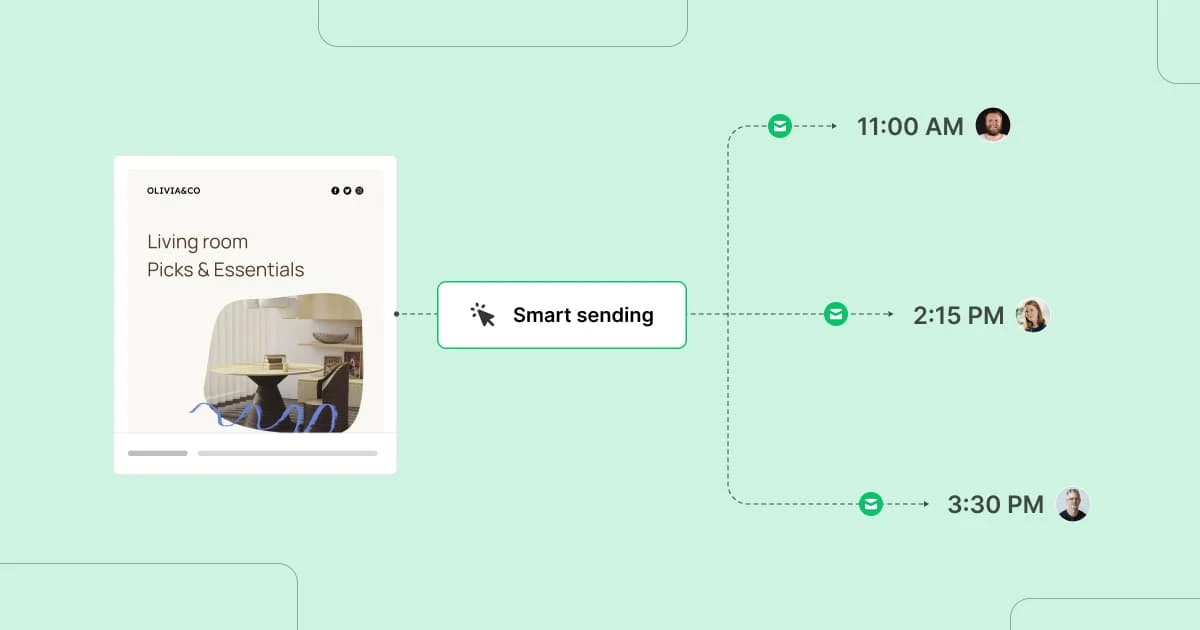
Smart sending automatically analyzes historical data to determine the best send time for each subscriber, then continues to analyze and adapt to your audience the more you use it. Pretty cool!
Auto-resend
Most email opens will happen within an hour of arrival. If your message is very important, use auto-resend to re-engage your subscribers without lifting a finger. With this feature, your email will resend automatically to everyone who didn’t open it the first time.
You can add a personalized message to the second email to let people know it’s important. When resending unopened email campaigns, the goal is to make everyone feel as if the second email was designed especially for them.
Deliver emails by time zone
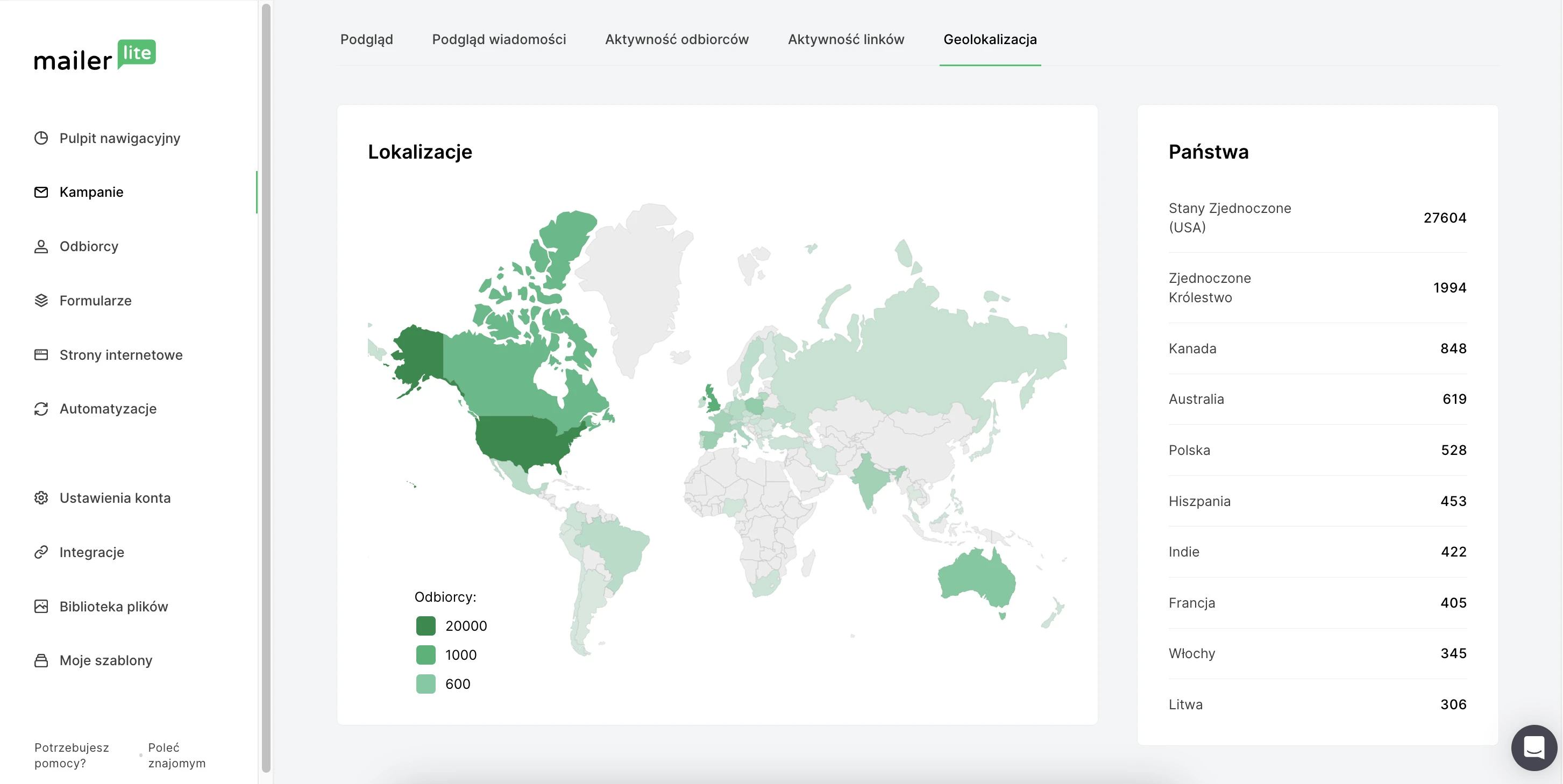
With MailerLite, you can check your ‘opens by location’ to understand where your subscribers are based. When you deliver emails by time zone, you don’t risk delivering newsletters to your international audience at off-peak times. Each reader will receive the newsletter at the same time in their own time zone. Just bear in mind that some location and open tracking may now be affected by Apple Privacy Protection.
Analyze your campaign performance precisely using AI and MCP
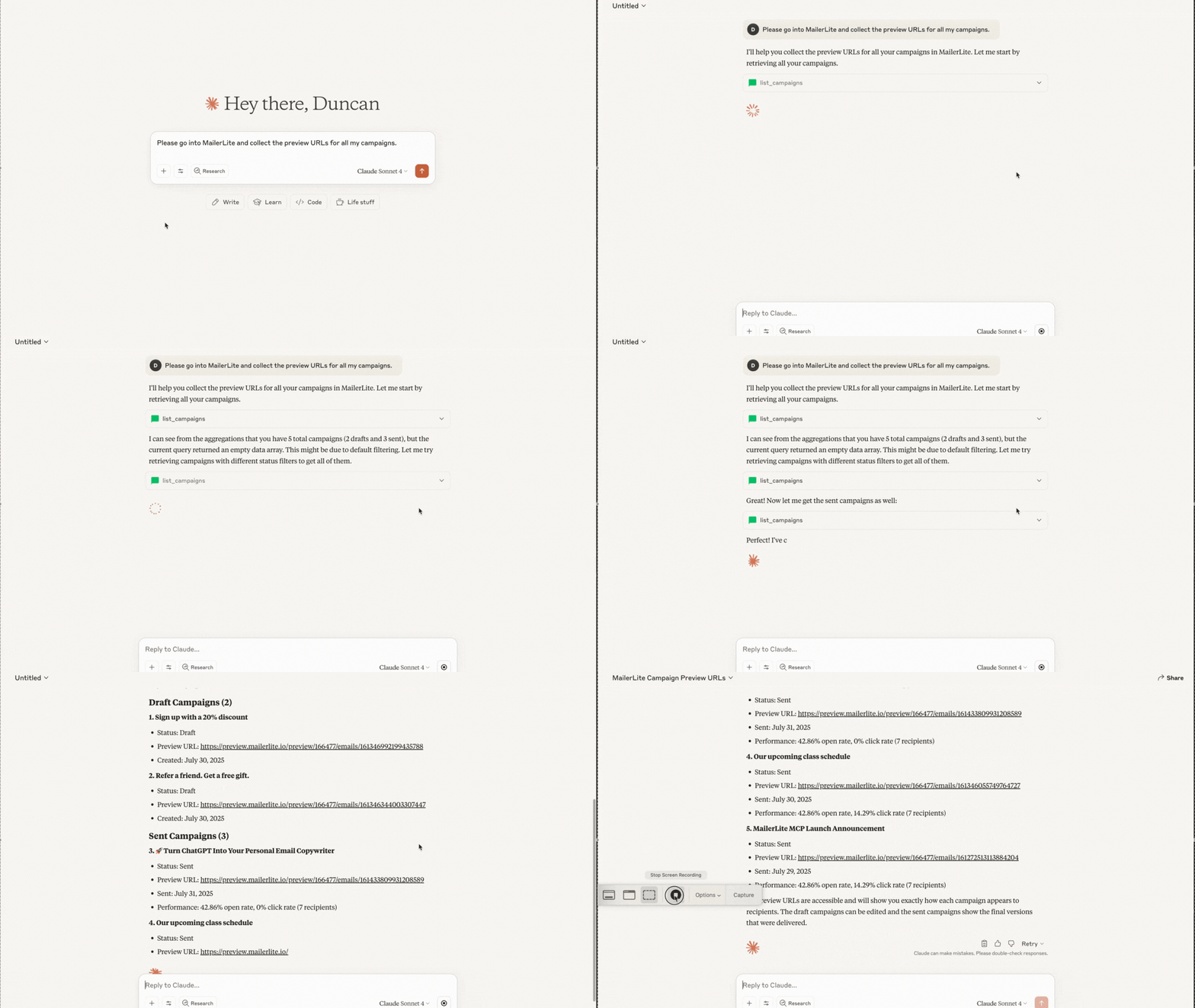
Connect your favorite AI platform, like ChatGPT or Claude, directly to your campaign data using MailerLite’s Model Context Protocol (MCP). This powerful integration lets you query the performance of your entire email history using natural language prompts.
For example, you could prompt AI to: “Find all my recently best-performing campaigns with an open rate over 40% and present their preview URLs.”
This fetches you precise data and deep insights instantly, saving you a ton of time and giving you the exact information you need to work with your specific audience.
Learn more about MCPs here:
Link triggers
Sometimes, you can use automation triggers to send emails at the perfect time. Instead of trying to work out the best time to send a newsletter to your entire email list, link triggers send individual emails based on each subscriber's action.
When a reader clicks on a link in your email campaign, they can trigger another email that matches the topic they are interested in at that very moment. This takes out the guesswork and lets the subscriber's behavior dictate a good time to send your message.
A/B testing and Multivariate testing
Send time isn’t the only factor that influences email open and click rates. Your email subject line, sender address, and email content can also be major players. Fortunately, you can test out these 3 things and more to find out which one generates the most engagement.
A/B testing is where you create 2 versions of the same email (e.g. with different subject lines), and then send them to a sample of your audience. The version that generates the highest opens or clicks* will be declared the “winner” and get sent to the rest of your email list.
Multivariate testing is similar to A/B testing, only it allows you to go much deeper by testing different combinations of variables for a more advanced look into what resonates with your audience.
*Since the Apple Mail Privacy Protection feature was released on 20 September 2021, we recommend A/B testing by click rate rather than open rate.
Best time to send email newsletters FAQs
Q: Is it better to send emails in the morning or evening?
The data shows that email open rates peak between 8 AM and 11 AM, while click rates peak between 8 PM and 9 PM. This suggests that if your goal is visibility, then the morning would be a better time to send. And if your goal is for subscribers to take action, then sending your campaigns in the evening may work better.
Q: What time is the highest open rate for emails?
The time of day that results in the highest open rate for emails is 9 AM - 10 AM, except for Wednesdays and Fridays, when the time that gets the most opens is 11 AM and 6 PM, respectively.
Q: What is the best day to send promotional emails?
The best day to send promotional emails depends on your industry and goal. However, the data shows that, on average, campaigns sent on Fridays generate the most opens and clicks. If we break it down by some popular industries:
- Creators get more opens on Tuesdays and more clicks on Mondays
- Entrepreneurs and SMBs get more opens on Thursdays and more clicks on Wednesdays
- Institutions get more opens on Saturdays and more clicks on Fridays
- E-commerce gets more opens on Fridays and more clicks on Tuesdays.
Q: Why does email sending time matter?
Email sending time matters because there are specific times and days when your subscribers are more likely to open, engage with, and take action on your email campaigns. For example, if you send an e-commerce campaign when the majority of your audience is working, they'll be much less likely to open it.
Q: Which day of the week is everyone sending their campaigns?
Thursday is the most popular day of the week for sending email campaigns, followed by Friday and Wednesday. It's worth testing out alternative days with your audience to see if a day that has less inbox traffic gives your campaigns more visibility.
Q: How can I determine the optimal time to send my email newsletter?
To find the best time to send your email newsletters, you first need to define whether your goal is visibility or action. Data shows that 8 AM - 11 AM seems to be the sweet spot for getting more opens, while 8 PM - 9 PM gets more clicks. You'll also want to consider how your industry and audience line up with average benchmarks.
This will give you a starting point, but the best way to learn the optimal time to send your campaigns is to test and learn what works for your subscribers. What's more, email service providers offer features, such as MailerLite's Smart Sending, that send out campaigns based on when each subscriber is more likely to open them.
The truth about email sending times
When all's said and done, sending time is a minor detail in the broader email marketing strategy. Your audience will open and read emails because of the content and value that you provide them with. It’s no good sending your email newsletter at the perfect time if it doesn’t match up with other email marketing benchmarks.
So, if a deadline is coming up, and you’re not happy with your email, wait until it’s ready. It’s better to deliver a quality experience, rather than sacrificing it for the sake of a specific date and time. When your readers are looking out for your newsletters with excitement, the timing becomes less relevant.
To wrap up, here are your main email sending time takeaways: for 2026
Prioritize the click rate over the open rate, as the best time to read might not necessarily be the best time to act.
Traditional 10 AM sends are now for visibility, not usually for conversion
Use the Friday 6 PM window for high-value campaigns; it's the strongest overall alignment point of the week
Align your send time with your industry's specific action window
Remember: High-quality newsletters are more important than perfect timing
Have you found the perfect sending time for you? Tell us about it in the comments.
Editor's note: This post was originally published in September 2020. It has been updated with new insights from our 2025 data.