How email marketing freelancers can find more clients (and keep them)

 Renata, Compliance Officer
Email marketing freelancing is one of the highest-leverage careers in marketing right now.
According to Hubspot, 75% of marketers plan to invest more in email in 2027, and the channel still delivers an ROI of $10 to $36 for every dollar spent (something paid social and search can't touch).
The opportunity is even bigger for specialists. As AI commoditizes generalist email work and inboxes get more crowded, freelancers who go deep on a niche, a platform, or a service area are the ones clients are actively seeking out and paying premium rates for.
This guide is for email marketing freelancers at every stage: those struggling to land their next client, established freelancers picking up MailerLite accounts, and anyone thinking about growing into a small agency.
We'll cover how to position yourself, find clients through warm outreach, master the platforms your clients use, and build a sustainable career around the work.
What does an email marketing freelancer actually do?
Email marketing freelancers handle the strategy, setup, and execution of a business's email program, the work that keeps subscribers engaged and converts them into customers.
That typically includes: writing email campaigns and subject lines, building automated flows (welcome sequences, abandoned cart, re-engagement), managing list growth and segmentation, and reporting on performance metrics like opens, clicks, and revenue.
Most working freelancers get by with an email marketing platform like MailerLite to do the core work. Plus, you can use our Bookings feature to handle client consultations, and sell digital products like “email strategy playbooks” directly on the platform.
Round it out with a project tracker like Notion or Trello, tools from Microsoft, and a simple invoicing tool like Wave or Stripe. Start small and build your toolkit as your business grows.
Why is now a perfect time to be an email marketing specialist
A few shifts have made specialist email work more valuable, even as AI eats parts of generalist digital marketing.
Email is the channel businesses actually own
Social media reach is unreliable, paid acquisition costs keep climbing, and SEO is more volatile than it's been in a decade. Email is the one channel where the relationship belongs to the business, which is why for B2C brands, email marketing now ranks as the #1 ROI-driving channel, beating paid social and content marketing.
As our customer Scott Baptie says:
Email is my best source for selling. Even when new trends come along, email is the most consistent source of sales.
ESPs have gotten more powerful, making platform expertise a real asset
Modern email platforms include features like automation tools, behavioral segmentation, multivariate and A/B testing, and AI-assisted writing.
The payoff for using them well is significant. Automated emails convert 31% higher than non-automated ones, and targeted campaigns see open and click-through rates up to 36.69% and 267% higher than untargeted ones. Those are the kinds of gaps clients are paying specialists to close.
Clients are increasingly platform-loyal
A few years ago, freelancers generally migrated clients to whichever ESP they personally preferred. That's gotten harder to justify. Migration is expensive, breaks historical data, and clients increasingly push back. The freelancers winning right now meet clients on the platform they're already using.
For example, a client already on MailerLite is good news for you: it's a platform built around exactly the features that drive the results you'll be measured on.
Build your email marketing career foundation: Niche, packages, and proof
Strong freelance email marketing careers are built on 3 foundations: a defined niche, thoughtfully-packaged services, and visible proof of your work credentials. Each makes the others more valuable.
Pick a niche that compounds
Generalist email freelancers compete on price, but email marketing specialists compete on results. Niching down is the highest-leverage move you can make as an email marketing freelancer. Here are 3 ways you can niche down:
By industry
This is the most common path. E-commerce, SaaS, online creators, B2B services, and nonprofits each have distinct email needs, buying patterns, and benchmarks, so a freelancer who works inside one industry compounds expertise fast.
After a few projects, you know what good open rates look like for that vertical, what offers work, and what deliverability quirks to watch for.
By the way, if you're curious about those metrics, check out our email marketing benchmarks by industry.

By service area
Some freelancers specialize less by industry and more by what they do: lifecycle marketing, retention and win-back, deliverability, or newsletter strategy. This works well if you've built deep technical skills in one area and your client base spans multiple verticals.
Note: Some freelancers stack both, like "lifecycle marketing for e-commerce brands," but most lead with one.
By email marketing platform
There's also a third option: niching by email marketing platform. Some freelancers list 5 or 6 ESPs on their portfolio and master none of them. Someone who deeply knows one platform is more valuable to clients on that platform than someone who has partial knowledge of many.
For example, MailerLite specialist is a legitimate niche, especially for freelancers who want inbound rather than outbound lead flow.
To define your niche, look backward. Which past clients or projects did you most enjoy? Which produced your best results? The intersection can be your niche.
Build packages for the email marketing services you sell
Niching down tells you who you serve. The next decision is what you sell them. Many successful freelancers build their business around a few repeatable packages rather than custom-quoting every project from scratch.
The common deliverables clients pay for include high-converting email content and packages like the ones below:
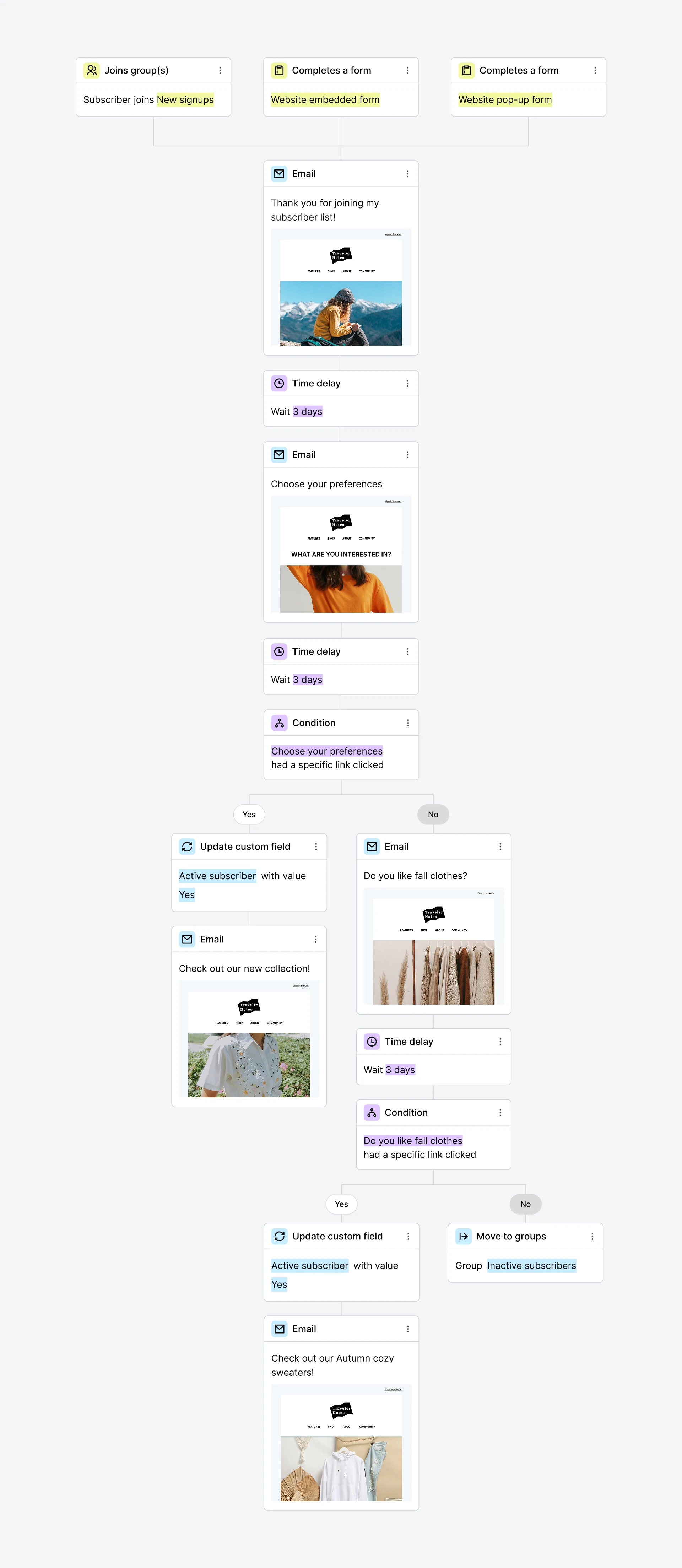
Welcome flow setup: A 4 to 6 email automation triggered when someone joins the list. This can be a solid mid-range project income-wise, and a common entry point with new clients.
MailerLite offers 15 automation templates to help customers quickly build their workflows with a few tweaks. Here’s our advanced welcome email automation template:
Lifecycle audit: A review of the client's existing email program with concrete recommendations. Often the lowest-friction way to start a relationship since it's a one-time deliverable with clear scope
List cleanup and automation segmentation: Removing inactive subscribers and rebuilding the segmentation logic. This could be smaller in dollar terms but often the fastest way to deliver a visible win early in a new client relationship
Abandoned cart flow (e-commerce niche): Typically the highest-ROI project an e-commerce email marketing freelancer can sell, which means it can command premium pricing
Check out our abandoned cart automation template below:

Monthly retainer: This includes ongoing strategy, email marketing campaigns, and optimization. Monthly retainers can result in stable income, but they’re usually only worth pitching after you've delivered one solid project or have built up some experience
Note: Clients aren't buying emails, they're buying revenue, retention, or list health. The trick is naming each package in terms of business outcomes, not deliverables. For instance, "Welcome sequence revenue setup" sells better than "5-email welcome series."
Gather the proof clients need to hire you
Email marketing is one of the few services where you can demonstrate competence directly through your own list.
A freelancer pitching email work whose own newsletter is a mess is hard to take seriously. A freelancer whose welcome sequence, segmentation, and writing voice are obviously good has already shown the prospect what they'll get.
Here are 3 pieces of proof that matter the most:
Your own email list and newsletter
This is your portfolio. Run the playbook you'd run for a client: a clear lead magnet, a tight welcome sequence, a sustainable cadence, audience segmentation and personalization that demonstrates you understand intent.
Prospects will subscribe to evaluate you before they hire you, so make sure what they see reflects the work you'd want them to pay for.
MailerLite gives you everything you need to set this up in one place: a landing page builder for your lead magnet, signup forms and pop-ups to capture subscribers across your site, an automation builder for your welcome sequence, and groups and segments for behavior-based targeting.
Sign up today!
MailerLite' Free plan covers up to 250 subscribers and 2,500 monthly emails, which is plenty to run a polished portfolio newsletter while you build your audience.
Here are some email newsletter templates from our template gallery that work beautifully for a freelancer newsletter:
Case studies with real numbers
Show off what you've achieved for your clients. Metrics worth highlighting include open rates, click rates, revenue attributed, list growth, and deliverability improvements.
Get permission to publish results, or anonymize ("a SaaS company in project management"). Also remember to collect testimonials from clients to highlight on your website.
Credentials and ongoing learning
Certifications signal that you've put in the work to learn a tool deeply, which lowers a client's perceived risk of hiring you. Pairing them with ongoing learning keeps your skills sharp as platforms and best practices evolve.
You'll find plenty of free guides on email marketing across our blog, knowledge base, and official YouTube channel. You can also sign up for our free webinars to learn from our experts live.
How to find clients through warm outreach
With the foundations in place, it's time to put yourself in front of clients. The most reliable way to do that is warm outreach: reaching people through channels where they've invited contact, or where you already have a connection. It keeps your pipeline healthy long-term and protects your reputation as an email professional.
A quick note on cold emailing: Sending unsolicited emails to people who haven't given you permission isn't allowed on MailerLite. Our anti-spam policy requires explicit permission before you email anyone. The tactics below rely on people who have opened the door themselves.
Look for businesses with a visible email gap
Sign up for newsletters in your target industry. The ones with weak subject lines, broken segmentation, or no welcome sequence show you exactly where you can help. Instead of emailing the sender directly, reach out through the channels they've set up for enquiries, like their contact form, a "work with us" page, or a LinkedIn message to their marketing lead. You're offering a specific fix to a specific problem you've already noticed.
Apply to agencies in adjacent specialties
Brand agencies, graphic design studios, and content shops regularly need an email specialist for client work but don't want a full-time hire. Many have freelancer or partner applications on their websites. A thoughtful application to 30 agencies serving your niche can produce reliable work for years.
LinkedIn alerts for newly hired marketing leaders in your target industries are another goldmine. Connecting and congratulating them on the new role is a natural way to start a conversation.
Ask your existing network
Former colleagues, past clients, and people in communities you're active in are your warmest leads. Let them know you're taking on new work and ask if they know anyone who needs help with email. Referrals convert faster than any pitch.
Write a pitch that gets replies
Here's a template you can adapt for contact forms, freelancer applications, or LinkedIn messages. The structure includes: specific opener, brief intro, concrete observation, low-pressure ask.
Hi [Name],
I subscribed to [their newsletter] last week and went through the welcome sequence yesterday. The [one specific thing you genuinely liked] is well done, and [one sentence on why it stood out].
One thing I noticed: [one specific, observable gap, e.g., "the welcome sequence ends after the first email," "the segmentation seems to be based only on signup source," "there's no re-engagement flow for inactive subscribers"]. In my experience working with [their niche or similar companies], closing this gap is usually worth a meaningful lift in [revenue per subscriber, re-engagement, list health, etc.].
Quick intro: I'm an email marketing freelancer who works with [your niche]. Recent example: [one-sentence result from a real project, with a number].
I'm not pitching anything specific. But if [the gap you noticed] is on your radar this quarter, I'd be happy to send over two or three concrete ideas, or jump on a 15-minute call. Either way, thanks for the work you're putting out.
[Your name]
[Portfolio link]
Follow up, then let go
Most people you pitch won't hire you right away. But the ones who say "not right now" could become clients later if you stay in their orbit. Rather than adding them to your list, share your signup link and let them decide: "If now's not the right time, no worries. I send a monthly note on [your niche topic]. You can subscribe here if you'd like to stay in touch: [signup link]."
Only people who sign up themselves belong on your list. A year from now when they need help, you'll be the freelancer they remember, and your list will be full of people who actually asked to hear from you.
Need a place to send people who want to stay in touch? Create a signup form or landing page in minutes and start growing a list the right way.
Turn your MailerLite expertise into a competitive advantage
If your new clients are already on MailerLite, that's a great opportunity. Instead of pitching a migration that would cost weeks of project time and reset their historical data, you can start delivering value immediately by going deep on the platform they're already using. That's how freelancers win retainers and turn one project into many.
Three practical moves to get to deep MailerLite proficiency fast:
Work through MailerLite Academy. It's free, structured, and covers everything that matters for client work: automations, segmentation, deliverability, landing pages, and reporting
Practice in your own account. Run your portfolio newsletter on MailerLite (the Free plan covers up to 250 subscribers). Build the kinds of automations and segments you'd build for clients, but on your own list. You'll learn the platform's quirks faster by hand than through any course
Lean into the compounding effect. One MailerLite client often becomes the gateway to more. Once you've delivered great results, it's easier to recommend the platform to other prospects and bring them onto a tool you already know inside out.
Earn an extra revenue stream through the MailerLite Affiliate Program
When you bring a new client onto MailerLite, you can earn 30% commission on their lifetime spend through the MailerLite Affiliate Program.
YNK media, a Slovakia-based agency, has earned over $13,500 through the program. Founder Stevie Jacák reinvests it directly into the team.
We use the money to make something better for our employees and company. Last time we completely renovated our office.
If you're already recommending an ESP to clients, recommending one with a built-in affiliate revenue stream means your earnings grow with each new account.
It also reinforces the case against migrating clients off MailerLite: a migration project might bill $3,000 once, but keeping a client on MailerLite for several years and earning 30% on their plan, on top of your project fees, often pays better.
Thinking of building a small email marketing agency?
As you grow and scale, you could eventually hit a ceiling: more inbound work than they can deliver alone, but no desire to run a 20-person agency. The middle path, a 2 to 4-person team, is one of the most stable structures in this industry.
A few things to keep in mind:
Hire for what you don't want to do: If you love strategy but dislike building flows or coding HTML, hire a builder. The instinct to clone yourself is wrong; you want to extend your bandwidth, not duplicate it
Lock in your processes before you hire: Onboarding docs, project templates, clear hand-offs. If you can't explain how you work in writing, you're not ready to delegate
Use platform features that scale with the team: MailerLite includes features perfect for agencies, including: account switching (jump between client accounts with a click), unlimited user seats on the Power plan, and granular permissions so each team member or client only sees what they need.
Common pitfalls to avoid as an email marketing freelancer
Let’s look at the most common mistakes that quietly cost email marketing freelancers money and reputation:
Underpricing because you're early
Email work has measurable ROI, which means it can sustain higher rates than most freelance services. Charging $500 for a welcome sequence that will generate $50,000 in revenue leaves money on the table and signals low expertise. Price against the value you create, not the hours you spend.
Letting scope creep eat your margins
Email projects expand fast: "While you're in there, can you also fix the abandoned cart flow and write a few email campaigns?" Your answer should be either a firm “no”, or, charging more for the extra work. Define scope tightly in your contract and price extra additions as new projects.
Recommending migrations to justify your fees
Migrating a client to a new ESP is sometimes the right call. More often, it's the freelancer's preference dressed up as strategy. If a client is happy on their current platform and the platform can do the job, your role is to do high-quality work inside it.
Grow your freelance email marketing career with MailerLite
The email marketing freelancers who build sustainable businesses do 3 things consistently: they pick a tight niche, they treat their own email marketing strategy as their best portfolio piece, and they continue with their outreach efforts even when the pipeline feels full.
Start a free account on MailerLite and run your portfolio newsletter on the same platform your future clients will use.
Frequently asked questions
Q: How much does one make in freelance email marketing?
A: Rates vary by niche and experience, but specialists with a strong reputation in a tight niche tend to command the highest rates. Annual income depends heavily on whether you're billing per project or running retainers; experienced retainer-based freelancers can cross six figures.
Q: How do I land my first client with no portfolio?
A: Three paths work: do 1-2 projects at reduced rates in exchange for a detailed case study; run a top-tier email program for your own list and use it as your portfolio piece; or partner with an agency that needs overflow help. All three give you real proof of work to show the next prospect.
Q: What skills are essential for success in freelance email marketing?
A: Beyond knowing your way around an email platform, the skills that matter most are copywriting for email content, subject lines, and calls-to-action, an understanding of segmentation logic, basic design sensibility, and the ability to read email marketing campaign data and turn it into recommendations. Soft skills include clear client communication and the discipline to keep your own marketing running while you deliver.
Q: Can I earn money through MailerLite's affiliate program?
A: Yes. When you bring a new client onto MailerLite using your affiliate link, you earn 30% of that client's lifetime spend on the platform. It's free to join, and the link is automatically generated once you're enrolled. Many freelancers and agencies treat it as a passive revenue stream that grows alongside their client work.
Q: How do I handle a client whose ESP I don't know well?
A: You have 3 options: turn down the work, learn the platform fast through free trial accounts and certification courses, or sub-contract to a specialist while staying client-facing. The wrong move is bluffing. Clients can tell when their freelancer is googling basic platform questions.