The e-commerce email marketing strategy playbook for small teams
Running an e-commerce business as a small team or solopreneur means juggling lots of tasks. Your email marketing strategy can easily be forgotten, especially if you don’t know how to do it well.
But skipping email would be a mistake. It’s one of the highest-converting, most cost-effective channels available to online stores. And with the right strategy and tools, you can capture all the benefits without needing to be a pro.
This guide walks through exactly how to build that strategy, from list growth to automation to the tactics that separate high-performing campaigns from the rest.
How e-commerce email marketing helps you grow sales
E-commerce email marketing is the practice of using email to attract, convert, and retain customers for an online store. It’s everything from a pop-up that captures a new visitor's address to a post-purchase sequence that turns a one-time buyer into a repeat customer.
Plus, email marketing is an extremely effective way to generate sales because once people join your list, you can contact them as often as you want for just the cost of your email marketing platform.
Our data shows that the average email marketing conversion rate is 0.32%, meaning a list with just 1,000 subscribers could be generating multiple sales every time they hit send. And all the information you generate about what they buy and click on can be used to send more targeted offers that bring in sales.
How to connect your store and email marketing
MailerLite has prebuilt integrations with all the top e-commerce stores, including Shopify, WooCommerce, PrestaShop and BigCommerce. Head to our integrations page to choose the one you use and then follow the instructions to get set up.
A good e-commerce email marketing strategy has 4 main parts
When creating your e-commerce email marketing strategy, we recommend starting with these 4 main pieces:
List growth: Attracting new subscribers through forms and offers
Campaigns: One-to-many sends that promote products, sales, and content to your whole list or segments of it
Automations: Triggered emails that run in the background based on subscriber behavior
Segmentation: Using subscriber data to make both campaigns and automations more relevant
Get these 4 working together, and you’ll soon be sending emails that bring in sales to an ever-growing list.
Use these 5 methods to grow your e-commerce store’s list
You can't generate sales from an email list you don't have. Here are the four most effective ways e-commerce brands grow theirs.
1. Website forms and pop-ups (with the right offer)
Forms and pop-ups are still the backbone of list growth. Forms are typically embedded directly on a page, such as a signup box on your homepage, a dedicated landing page, or a section at the bottom of a blog post.
Pop-ups appear over the page itself, either immediately or after a trigger like time-on-page or scroll depth. They're more attention-grabbing than a form, but they also interrupt whatever the visitor was doing.
A good form or pop-up always includes an offer rather than just asking someone to sign up for updates.
For e-commerce stores, a welcome discount is one of the most common and effective offers, since it gives a new visitor an immediate, concrete reason to hand over their email address. It can also entice visitors to make their first purchase.
MailerLite has plenty of ready-to-use templates to get a pop-up live quickly, including interactive spin-the-wheels that turn the discount reveal into a small game.
2. Marketing consent at checkout
One of the easiest list-growth channels for e-commerce stores is to simply add your customers to your list.
When you connect MailerLite with your e-commerce store, you can add an email opt-in field directly to checkout, so all buyers will be synced with your email platform.
Subscribers who have already bought from you tend to be the most valuable people on your list. After all, it’s easier to sell to someone who already knows and likes your brand than it is to someone new.
3. A link-in-bio page
For brands with an active social following, a link-in-bio page is one of the simplest ways to convert followers into subscribers without needing a separate website build.
Just create content and then direct people to your link to join your list. Like with pop-ups and forms, you can include a welcome bonus to encourage people to join.
We have several link-in-bio landing page templates you can use, or you can create a targeted landing page built around your offer. Here are some of our most popular templates.
4. Giveaways with other businesses
Partnering with complementary brands to run a joint giveaway is one of the fastest ways to generate a large number of new subscribers. And our lead magnet data shows that these are also the highest converting offers.
Live The Creed founder Jonathan Barbera uses this tactic to quickly grow his e-commerce list by teaming up with other brands.
But giveaways have big tradeoffs, specifically that subscribers will often join your list to win the prize, then stop engaging once the contest ends.
Here are three ways to manage this:
Only team up with brands that share your audience, and make the giveaway prize something that only your customers would want
Build a dedicated automated sequence to nurture giveaway subscribers once they join your list
Track engagement closely in the weeks after the giveaway and remove or re-target anyone who doesn't interact
If you follow these steps, giveaways can work, even if the subscribers will never be quite as engaged as existing buyers.
5. In person or in store
If your e-commerce brand also sells in person, every transaction is a chance to grow your list.
Add an email signup field to your point-of-sale system, or set up a simple tablet or QR code at checkout that directs customers to your landing page.
The same principles that make online offers convert well apply in person, too. Offer a small incentive, like an instant discount or entry into a giveaway, to encourage people to sign up.
Check out this article for more ways to grow your email list.
Use these e-commerce email campaigns to generate the bulk of sales
Campaigns are the one-off emails you send to your list or a segment of it, and they are where most of your revenue will come from. In our data, campaigns generate 93% of tracked e-commerce orders.
Unlike automations, which we'll discuss later, you need to create new campaigns for every send. But, MailerLite has plenty of tools to make building campaigns fast.
Templates and duplication: Reuse a past campaign instead of building from scratch
Content blocks: Drag in pre-built sections like product grids or CTAs
Product boxes: Pull in product details and images automatically
Content templates: Save your own layouts to reuse across sends
Global styles: Set fonts and colors once, apply everywhere
AI subject lines: Generate options instead of staring at a blank line
Since campaigns have such a high conversion rate, we think that with the time-saving tools mentioned above, even the most time-strapped e-commerce founder will see the benefit of sending regular emails.
Announce new products
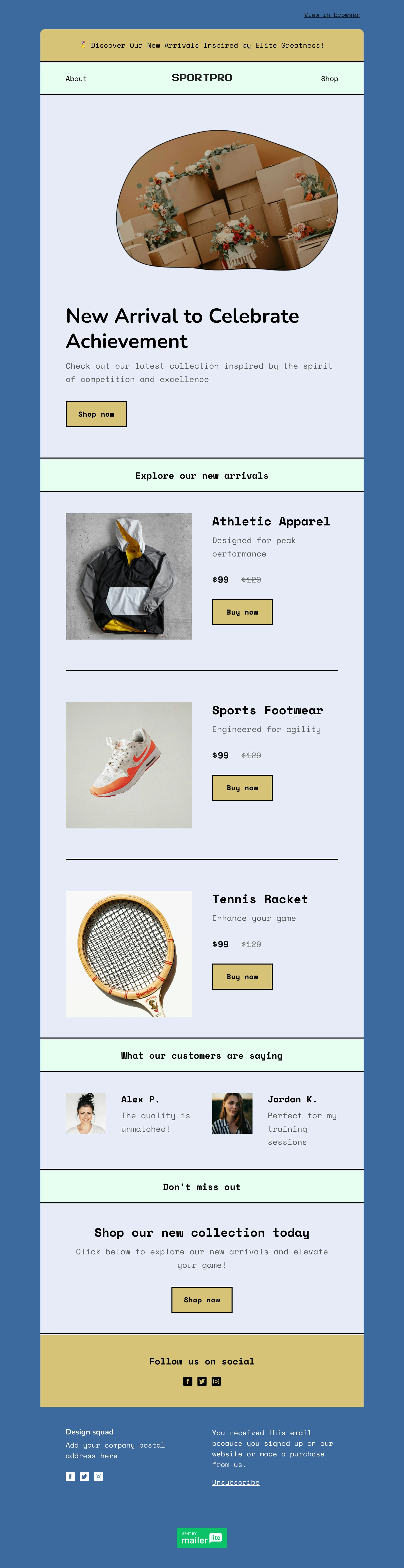
A new product campaign announces a launch to your list. It’s a great way to build momentum and generate sales of your latest product or collection.
Promote preorders
A preorder campaign lets customers commit to buying a product before it's officially available, usually in exchange for early access or a launch-day discount.
Home appliances brand Fridja used preorder campaigns to presell over 25% of stock before a product had even launched, taking pressure off release day entirely.
Being able to tell people that we have a new product has generated so many sales.
Sales and offers
A sales or offers campaign promotes a time-limited discount or promotion, giving subscribers a clear reason to buy now rather than later.
When promoting a sale, consider sending multiple emails. For example, one to announce the sale, one when it opens, one when you add further discounts, and one before it ends.
You could also use segmentation to send an email that gives your most loyal customers early access to the offer.
Low stock or last chance offers
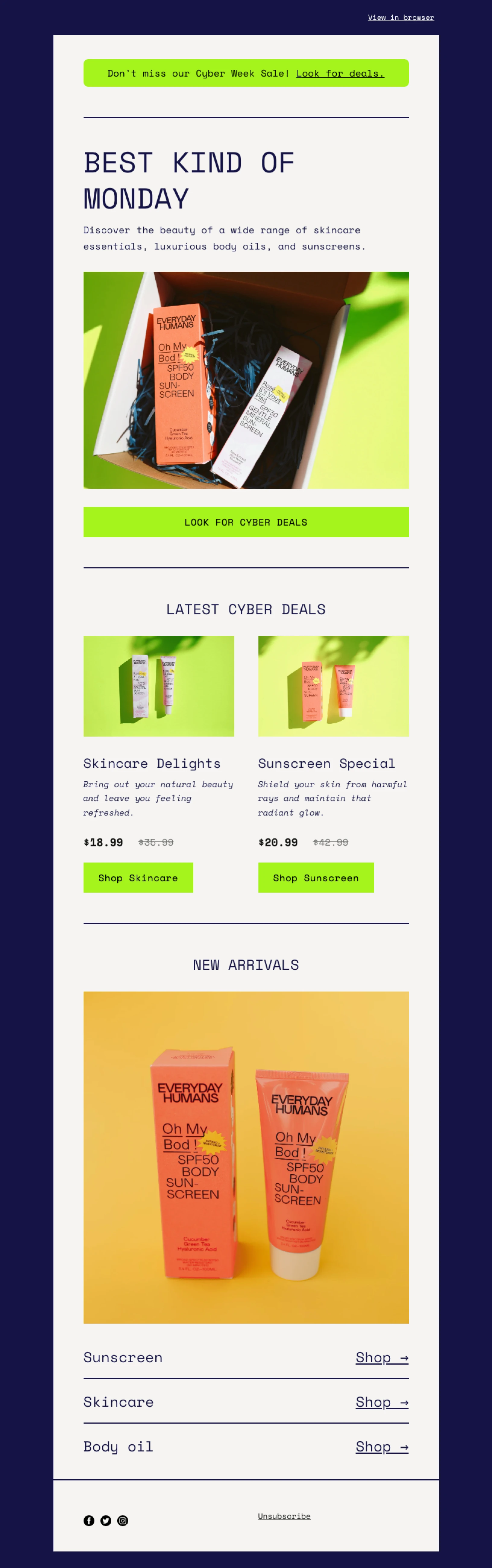
A low stock or last chance campaign uses scarcity to push undecided subscribers to act. These are especially effective for clearing out inventory or squeezing extra sales from the tail end of a promotion.
Interest-based
An interest-based campaign sends content tied to what a specific subscriber has already shown interest in, rather than a generic message to your whole list.
You can use the products people have purchased, the links they’ve clicked on, or the lead magnets they’ve downloaded to gather interest-related data.
Refer a friend
A refer-a-friend campaign asks existing customers to share your brand with people they know, often in exchange for a discount or reward for both parties.
It turns your existing customer base into a low-cost acquisition channel that doesn't rely on paid ads or algorithms. Check out this guide for an exact playbook for creating a referral marketing strategy.
Create email marketing automations that work in the background
If campaigns are where the bulk of your revenue comes from, automations are where the efficiency comes from. Set them up once, and they run indefinitely, delivering the right message at the exact moment a customer needs it.
This relevance means that email automations perform exceptionally well. Our data shows that the average open and click rate of automations is 47.82% and 16.88%, respectively, far above typical campaign benchmarks.
Automations also convert better per email sent: the average conversion rate for automated emails is 0.42%, 31% higher than the 0.32% average for campaigns. That's because automations are triggered by real intent signals rather than sent on a schedule.
Automations are triggered by actions that the subscriber takes. MailerLite has 13 email automation triggers, including 6 that are specific to e-commerce:
Abandoned checkout
Abandoned cart
Buys any product
Buys specific product
Buys from category
Purchase frequency
Since you can trigger automations when someone joins a segment, you can also use all our e-commerce segments to start automations, too. Learn more about all our email automation triggers and how to use them here.
Welcome email
A welcome automation is the sequence of emails a new subscriber receives immediately after joining your list, introducing your brand and setting expectations for what's to come.
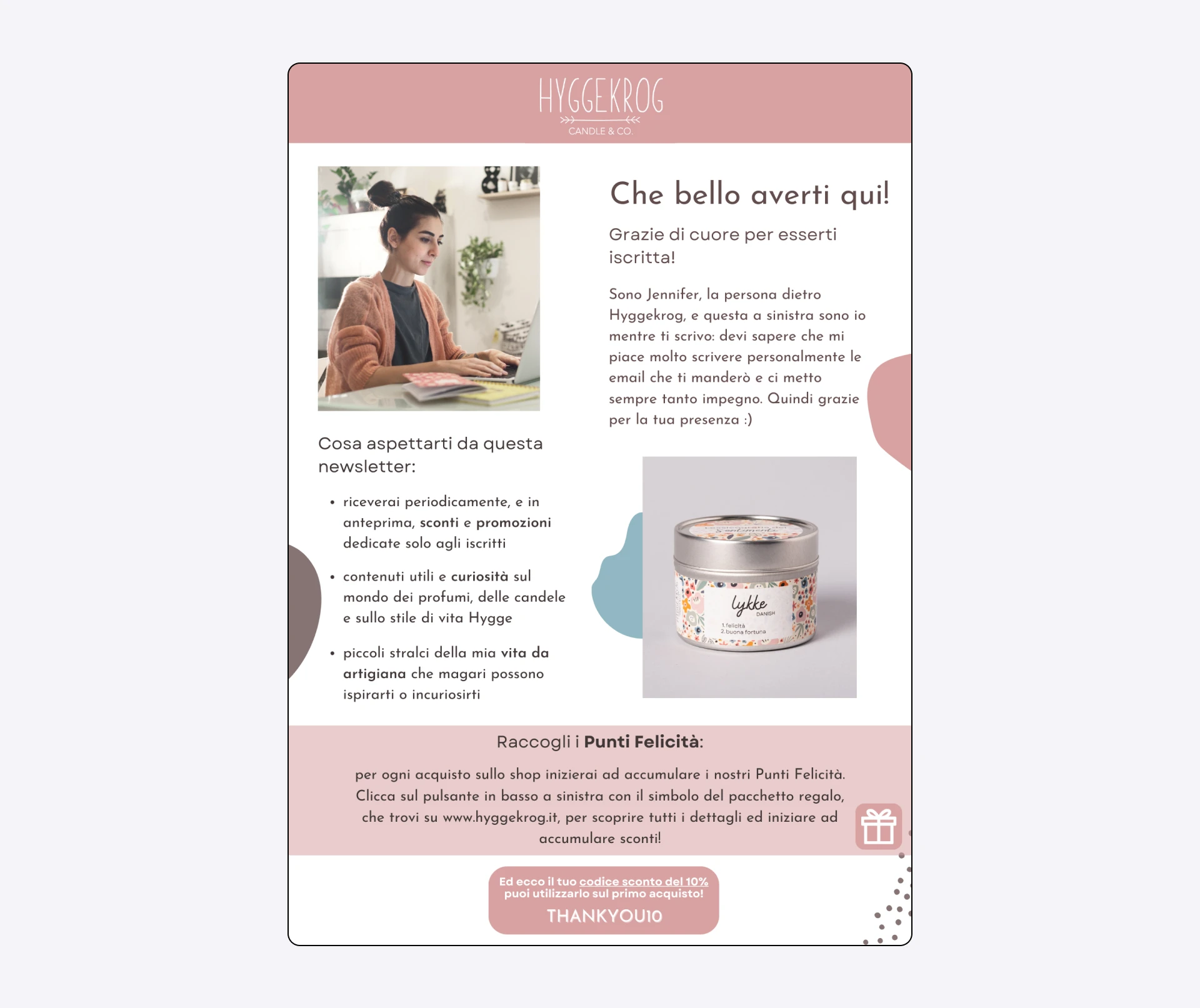
Hyggekrog uses a welcome automation that introduces the brand, highlights its loyalty program, and includes a first-purchase discount. Because it lands at the exact moment someone first engages, it gets an open rate of over 90% and a click rate of 32.94%.
Abandoned cart or checkout
An abandoned cart or checkout automation reminds someone who added a product to their cart (or started checkout) but didn't complete the purchase.
They’re effective since they go out to people who are already very close to making a purchase. In fact, these emails have a 12% click rate; sending them means lots more people clicking back to the checkout.

Post-purchase
Post-purchase automation follows up after someone buys, whether to increase the value of that purchase or set up the next one.
Live The Creed sends an automated email two weeks after a purchase promoting higher-ticket products, increasing repeat purchases and customer lifetime value.
Review request
A review request automation asks a customer for feedback after they've had time to use their product, building the social proof you can then use in future campaigns. Set the automation to go out a week or so after the purchase so people have time to receive and then form an opinion.
Birthday
A birthday automation sends a personal message, often paired with a small discount, on or before the subscriber’s birthday. It's a simple way to celebrate your customer, while the discount can also bring in sales.

Re-engagement
A re-engagement automation reaches out to subscribers who've stopped opening or clicking your emails, giving them a chance to reconnect before you remove them from your list.
It keeps your list engagement high, which is something that inbox providers love and can cause your messages to land in the inbox.
Purchase frequency emails
A purchase frequency or loyalty automation rewards subscribers for repeat buying behavior, whether that's a discount after their third order or a milestone reward for reaching a spending threshold.
Automating this means loyal customers are recognized consistently, without you having to track who's earned what.
Upsells based on products purchased
A product-based upsell automation triggers when someone buys a specific item, letting you recommend complementary or higher-value products at the moment they're most receptive.
The Buys specific product trigger has the highest engagement of any automation type in MailerLite's e-commerce data, with a 76.58% open rate and 28.43% click rate, since it's the most targeted trigger available.
More tips to boost e-commerce email performance
Once the foundational structure is in place, these tactics are what separate good email programs from great ones.
Each email should have one main goal
A common way to boost email performance is to include one main theme or offer in each email. This works because it lets you combine your subject line, copy and products in a way that works together.
Plus, you can combine this with segmentation to make sure that the most interested people are likely to get the email.
A/B test everything
A/B Testing removes the guesswork from what your specific audience responds to. You can include different subject lines, offers, products and messaging to see exactly what generates sales so you can refine your strategy and make each send more effective than the last.
With MailerLite, you can test your entire campaign including campaigns, automations, landing pages, and pop-ups.
Segment your audience
Targeted sending is one of the single highest-leverage moves in email marketing, since it lets you send the exact offers that people are most likely to respond to.
Segmentation is the key to targeted offers since it creates lists that you can send emails to. When you connect your store to MailerLite, we automatically create e-commerce segments for:
First-time customers: Users who have completed exactly one purchase
Repeat customers: Shoppers who have made more than 5 purchases
Zero-purchase customers: Subscribers synced from your store who have never bought anything
High-spending customers: Shoppers who spend more than $500
But you can also use our filtering options to create segments based on any data point stored in a customer profile, as well as how they engage with your emails and more.
Use AI strategically
AI tools can meaningfully improve performance when used in the right way.
For example, our subject line generator suggests options based on your campaign content. Since it’s trained on top-performing subject lines, our open rate data shows that campaigns using this tool had an average open rate 14% higher than those that didn’t.
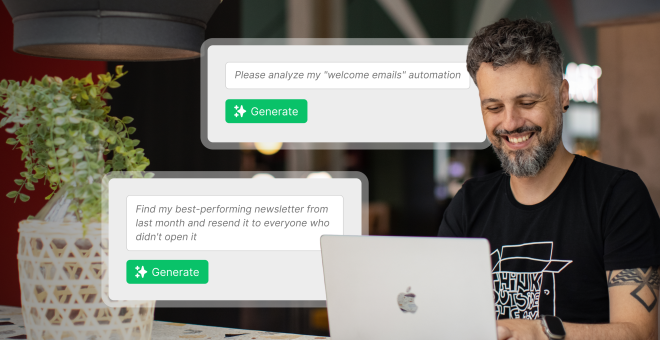
You can also connect your account to an AI tool like ChatGPT via the MailerLite MCP server, which lets you draft full campaigns, analyze what's worked in past sends, and get automation suggestions using plain-language prompts.
Personalization and dynamic content
Personalization lets you add information about a subscriber, such as their name, to an email. It helps you speak to customers in a way that feels more personal.
Meanwhile, dynamic content blocks let you show different content to different recipients within the exact same email. For example, if you’re promoting a sale, you could use one call to action for loyal customers, and another for people who have yet to buy.

Keep your list clean and engaged
One of the most important things that people often forget about is the need to keep their list clean. That’s because a list full of unengaged addresses can hurt deliverability, making emails sent from your domain more likely to land in spam.
Here are 3 steps you can take to keep things clean:
Remove inactive subscribers. Identify people who no longer interact with your campaigns. Consider running a re-engagement automation first to give inactive subscribers one last chance before removal.
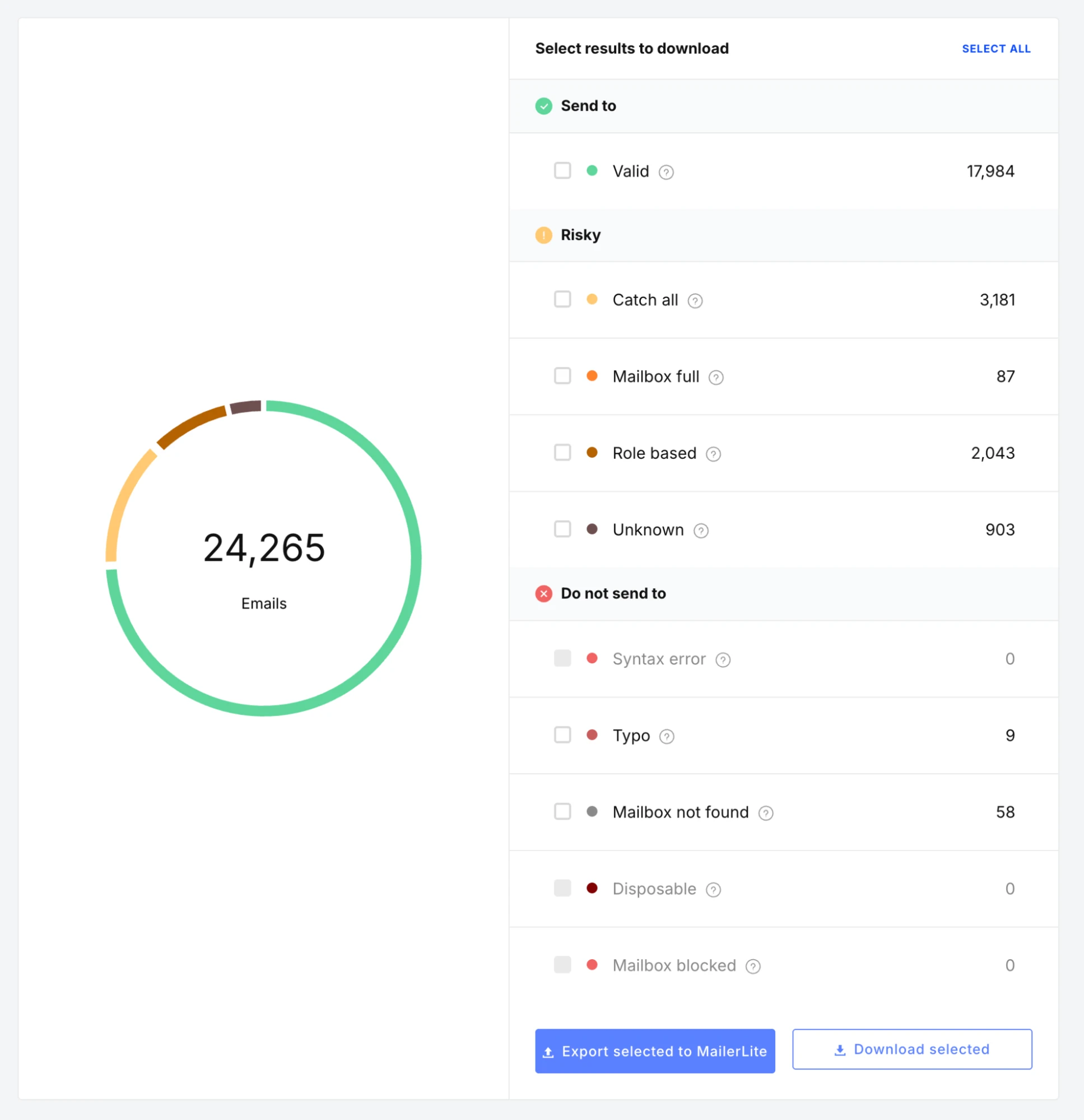
Validate your list. Regularly checking your list with an email verification tool like MailerCheck reduces bounces, keeps your sender reputation healthy, and protects the deliverability of every campaign and automation you send afterward.
Remove bounced email address: These are addresses that can’t be delivered to. If you use MailerLite, we do this automatically after every send.
Following these steps will keep your list clean and engagement high.
The top e-commerce email marketing tools to use
Most email tools have some kind of e-commerce features. But we think the two standout tools are MailerLite for small teams and solopreneurs, and Klaviyo for larger stores with dedicated email marketing teams.
MailerLite
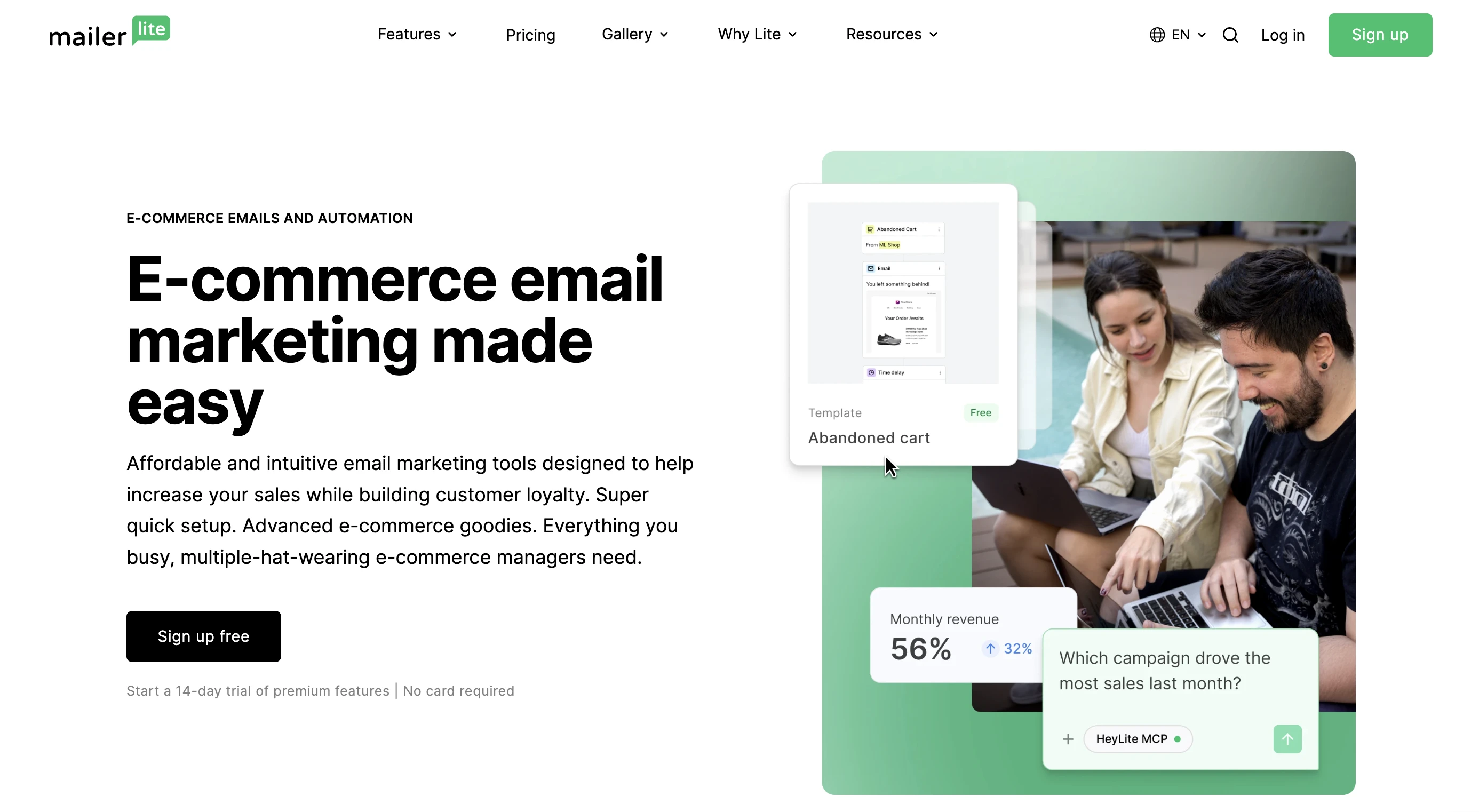
MailerLite is built specifically for lean teams and solopreneurs who need a complete e-commerce email toolkit without hiring a specialist or juggling multiple platforms.
Here are some of the key email marketing features:
Automation builder with e-commerce triggers like abandoned cart, buys a specific product, and subscriber clicks a link
Drag-and-drop campaign builder plus a rich text editor for fast, simple sends
Reusable templates let you save any campaign or block (like a sign-off or product feature) and reuse it across future sends
Landing page and website builder for lead magnets, product pages, and link-in-bio pages
Groups and segments for targeting by shopping behavior, interests, or engagement
E-commerce integrations with Shopify, WooCommerce, PrestaShop, and others, plus native product and booking sales tools with 0% MailerLite commission
Sales tracking built into the dashboard, plus custom reports for tracking orders, revenue, and conversion rate by campaign, group, or time period
Pros: All core e-commerce email features in one platform at an affordable price; easy learning curve.
Cons: SMS sending requires a MailerSend connection.
Sign up to try MailerLite with a free 14-day trial here
Klaviyo
Klaviyo is built for e-commerce brands that want very deep, granular data integration with their store, particularly Shopify.
Automation builder with a large library of pre-built e-commerce flows
Campaign builder with drag-and-drop design and dynamic product blocks
Segmentation based on granular store data like purchase history, predicted lifetime value, and browsing behavior
E-commerce integrations with deep native support for Shopify, plus other major platforms
Sales tracking with detailed revenue attribution reporting tied directly to flows and campaigns
Pros: Good granular segmentation and data-driven flows if you're on Shopify; strong revenue attribution reporting.
Cons: Pricing scales quickly as your list and order volume grow; steeper learning curve that can require more time investment than a small team may have to spare.
More e-commerce email marketing FAQs
What is the ROI of email marketing for e-commerce?
Email is one of the highest-converting, most cost-effective channels available to online stores, since once someone joins your list, you can email them as often as you like for just the cost of your platform.
While your exact ROI depends on factors like the price of the tool you choose and your store’s profitability, MailerLite data shows an average campaign conversion rate of 0.32% and an even higher 0.42% conversion rate for automated emails.
How do I build an e-commerce email marketing strategy?
A solid strategy has four parts working together: list growth (attracting subscribers through forms and offers), campaigns (one-to-many sends promoting products and offers), automations (triggered emails based on subscriber behavior), and segmentation (using subscriber data to make campaigns and automations more relevant).
Start by setting up your core automations since they only need to be built once, then layer in a regular campaign cadence, and use list-growth channels to keep feeding new subscribers into the mix.
What types of emails should an e-commerce store send?
On the campaign side: new product launches, preorder promotions, sales and offers, low-stock or last-chance pushes, interest-based sends, and refer-a-friend campaigns.
On the automation side: welcome emails, abandoned cart or checkout reminders, post-purchase follow-ups, review requests, birthday emails, re-engagement sequences, purchase-frequency/loyalty rewards, and product-based upsells.
Together, campaigns tend to drive the bulk of revenue (93% of tracked orders), while automations run in the background and convert especially well once set up.
What is the best email marketing tool for e-commerce?
It depends on your setup. MailerLite is built for lean teams and solopreneurs who want a complete e-commerce toolkit, including user-friendly tools for automation, campaigns, templates, landing pages, segmentation, and store integrations.
Klaviyo suits e-commerce brands wanting very deep, granular data integration with their store (particularly Shopify), but pricing scales quickly as your list and order volume grow, and it has a steeper learning curve.
How often should e-commerce stores send marketing emails?
There's no fixed number, but the best advice is to send an email when you have something to say. Our email cadence data shows that sending between multiple times per week and more than once a month can work well. But, since campaigns generate the bulk of revenue, we recommend sending at the more frequent end of this scale.
What is an abandoned cart email?
An abandoned cart email is an automated email that reminds someone who added a product to their cart (or started checkout) but didn't complete the purchase to buy.
Because these emails target people who are already close to buying, they perform well, with 12% of people clicking back to the cart.
Start your e-commerce email strategy today
E-commerce email marketing doesn't have to be a second job. With automation and time-saving tools, a lean team can run an email program that generates real sales.
Start with the automations, since they only need to be built once. Layer in regular campaigns to give your sales a boost. Then use your list-growth channels to keep feeding the top of the funnel.
Email marketing built for small teams
MailerLite is email marketing built to help small teams and solopreneurs thrive. It includes all the user-friendly tools you need to create genuinely effective email marketing strategies. Try it today with a free trial.
Add MailerLite as a preferred source on Google. It tells Google you trust us, so you'll see more of our content in Top Stories and AI Overviews.
Add as a preferred source